Intro
For twenty years the internet sold your attention to advertisers. Now it is teaching you to trade it yourself.
The internet's only true scarcity
Herbert Simon described[1] the mechanism before the web existed: a wealth of information creates a poverty of attention. Once content became near-infinite and near-free, the bottleneck moved from making things to getting them seen. Whoever held the user's attention held the value that attention produced.
Two decades of product design followed from that single constraint. Feeds, notifications, autoplay, the infinite scroll — none of it was engineered to serve you. It was engineered to hold you, because duration was the unit being sold. Attention was the oil; the platform was the refinery; you were the field.
The scarce resource was never content. It was the eyes in front of it.
How Platforms Turned Your Eyes Into Revenue
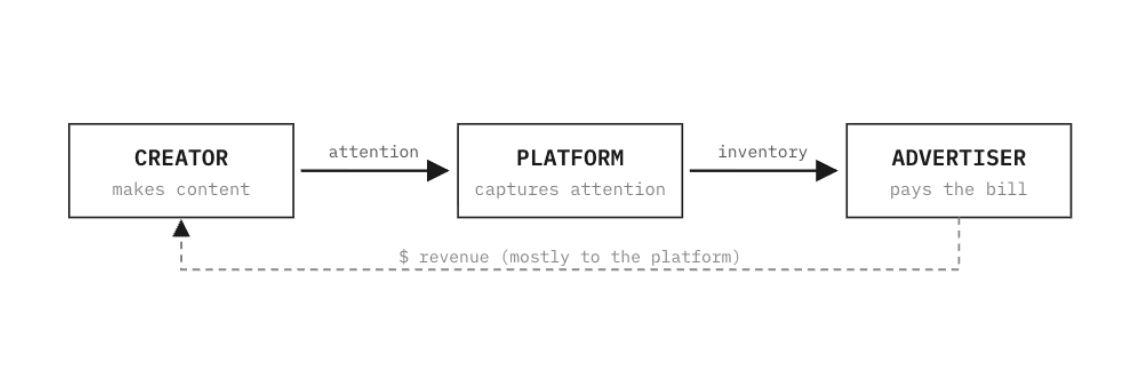
The conversion mechanism was advertising. Engagement metrics — time-on-platform, watch-through, click-through — became proxies for attention, and that attention was packaged and resold to a third party.[2] The user generated the raw material, the advertiser was the customer, and the algorithmic feed was tuned to maximize the volume and duration of attention that could be extracted and sold.
It was a linear chain, and it scaled astonishingly well: creator → platform → advertiser. For more than a decade, "attention captured" was the master metric of the consumer internet. The user is absent from the cash loop — they supply the asset but never price it.
Why "capture more" stopped working
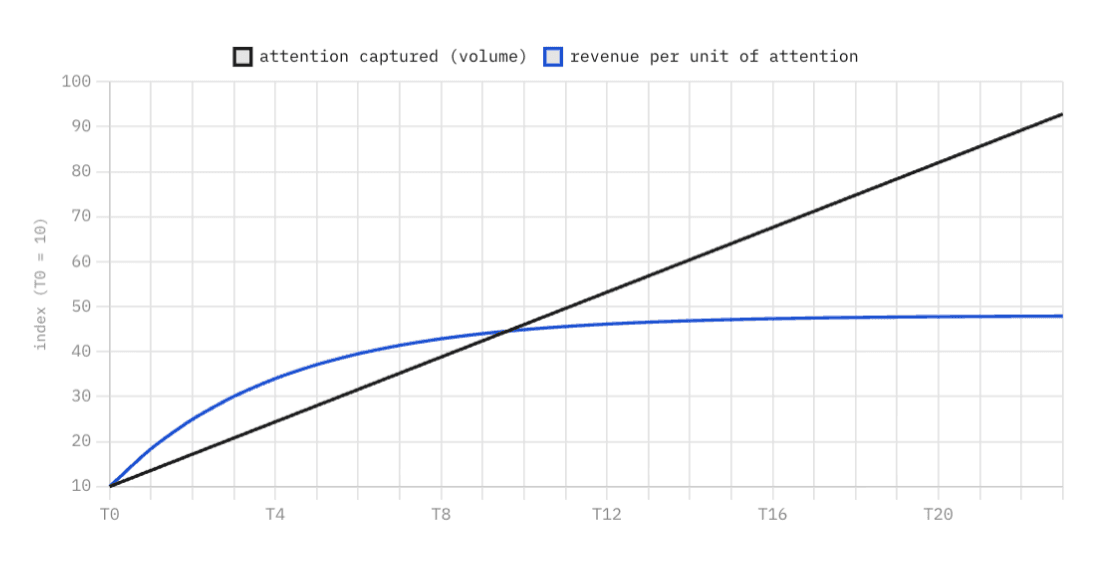
By the mid-2020s the model was visibly saturating. Ad inventory commoditized and CPMs softened even as raw engagement kept climbing. Privacy shifts — tracking limits, cookie deprecation, regulation — degraded targeting precision, lowering the monetizable value of each unit of attention. And users fatigued: more platforms chasing the same finite hours produced less marginal engagement per person.
The defect was structural. Attention kept being captured; the return on that capture stopped scaling with it. Engineering could not widen a pipe whose pressure was falling.
Attention stops being a product, it becomes the price
The response to the ceiling was not better extraction, it was a redefinition of what attention is. Instead of inventory sold to an advertiser, attention is reframed as a data signal with a direct, tradable value: a real-time read on where collective interest is heading. This is the premise of InfoFi — information finance — a frame popularized after Vitalik Buterin’s 2024 writing on pricing information and outcomes. Early instances skipped the advertiser entirely.
The question flips from "how much attention can you capture?" to "what is your attention actually worth right now?" That flip is the hinge of this entire note. Attention moves from being a product the platform sells to being market infrastructure the user operates.
Three products already trading it
This is no longer theoretical. Three live platforms operationalize "attention as signal" and they sit at different points on the same curve, from explicit financial instruments to invisible native behavior.
1. Trendle — the instrument end
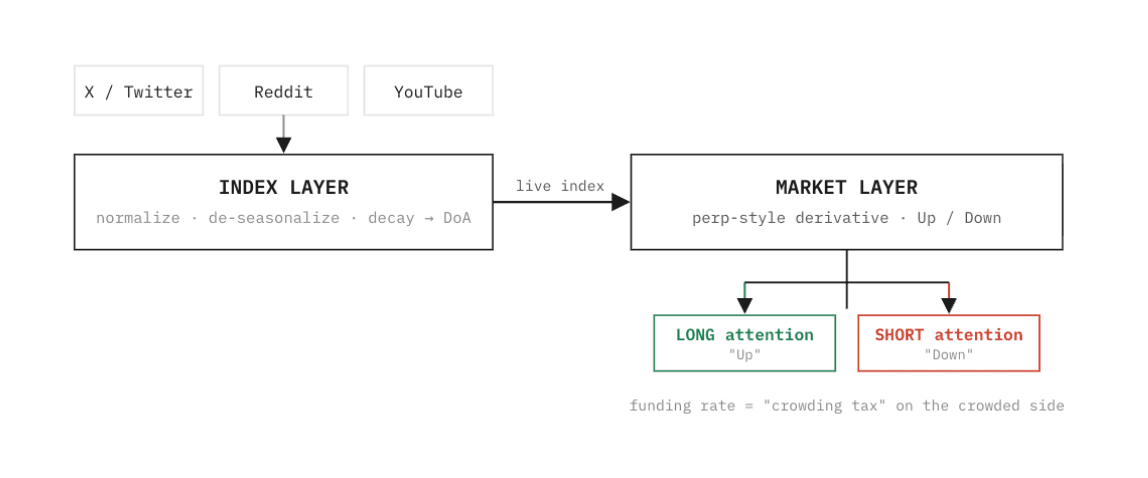
Trendle frames itself plainly as an attention market app. Users go "Up" or "Down" on whether a topic’s mindshare will rise or fade, with momentum measured by an aggregated Attention Index denominated as a Dollar of Attention (DoA), built from engagement across X, Reddit and YouTube and recomputed every minute. Architecturally it splits the system in two: an index layer that measures attention neutrally, and a market layer where traders price a perpetual-style derivative on top, with funding rates acting as a "crowding tax" on the overcrowded side.
2. Noise — trading relevance itself
Noise positions itself as a trading platform for relevance: long or short the attention paid to trends, brands and ideas, expressed as continuous relevance indexes rather than yes/no outcomes — so a position has no expiry, only a direction.
3. Giggles — the native end
Giggles is the consumer-facing version of the same logic. Structurally it’s a short-video feed in the TikTok mold; its one differentiator is that every trend on the platform is tradable — "like TikTok, but every trend is tradable, so anyone can make money while scrolling." Where Trendle and Noise ask a user to understand they’re trading an attention index, Giggles wraps that exact mechanic inside the familiar Gen Z interface.
This is the important part. The financialization of attention may require no new behavior at all. It can be layered directly onto passive scrolling — the precise habit the extraction-era economy already trained, at global scale, for free.
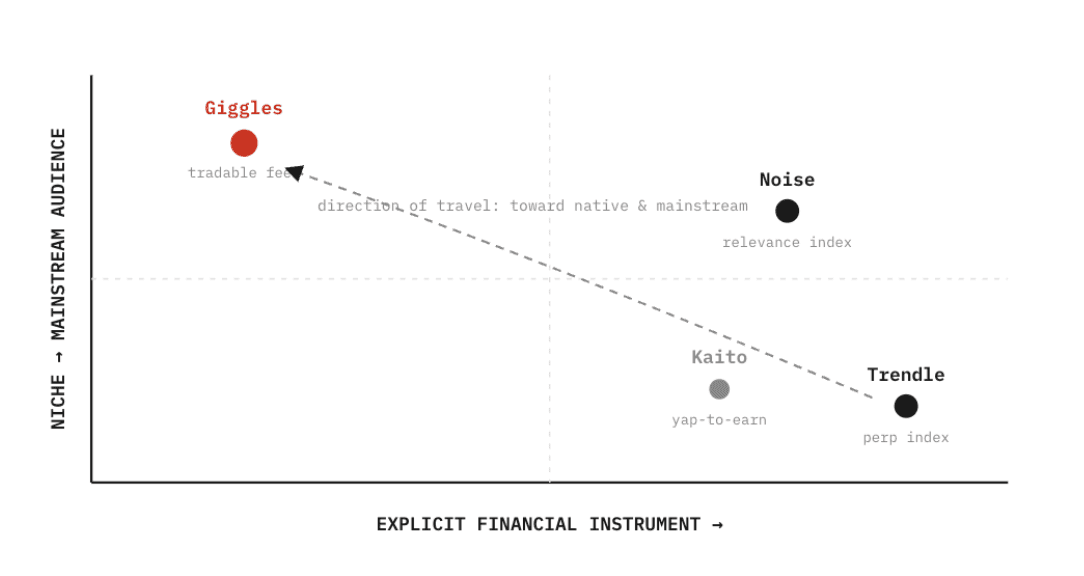
Plot them and the pattern is clear: one underlying primitive, attention priced in real time by the people generating it, packaged anywhere from an overt perpetual to an invisible swipe.
The system becomes reflexive
Once attention has a price, the loop bends back on itself. Creators no longer optimize only for views or ad revenue — they optimize for tradability: will this trend be one people want to take a position on? That changes what gets made, not just how it performs. The linear chain of the extraction era collapses into a loop where creators, traders and the platform each extract value from a different point.
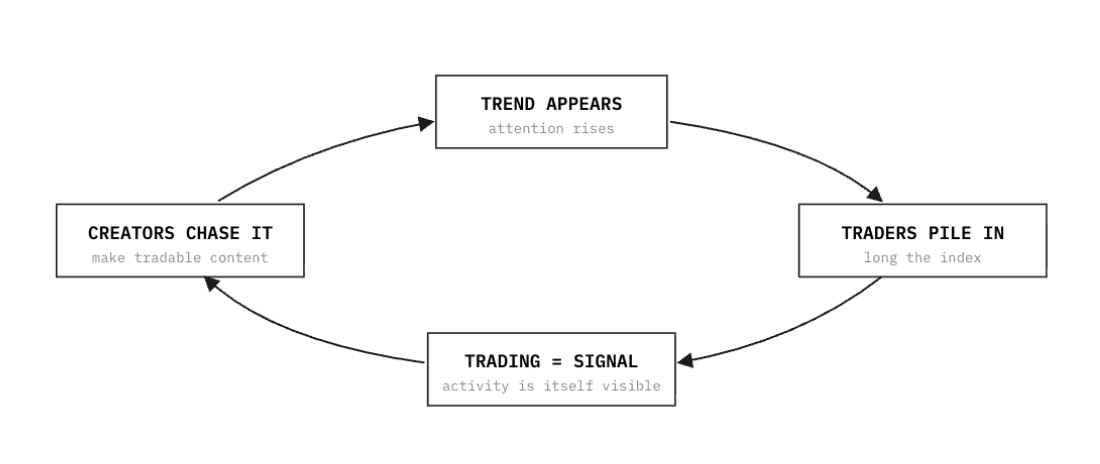
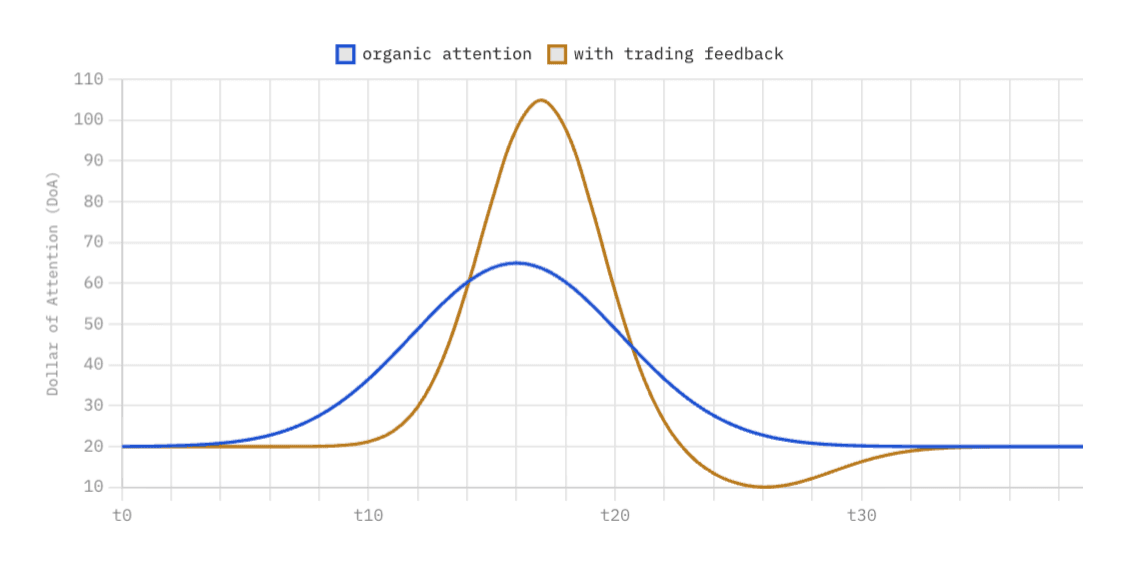
Reflexivity is also where the risk lives. If attention has a price, attention can be manipulated — coordinated engagement to pump an index is structurally a pump-and-dump on a low-liquidity asset. Feedback loops amplify volatility, and culture doesn’t just reflect speculation. It becomes a speculative asset class, with the volatility profile that implies.
The internet’s new financial layer
The attention economy is entering its second phase. The first treated attention as a resource to capture and resell, and scaled until it hit a structural ceiling. The second — visible in Giggles, Trendle and Noise — treats attention as a financial primitive: something with a live, tradable price, generated directly by the people paying it.
The open questions are real: regulatory treatment of prediction-market-adjacent products is unresolved,[3] manipulation resistance at scale is unproven, and no precedent tells us what happens to culture when every trend is simultaneously a piece of content and a financial position.
The attention economy is no longer just the behavioral layer of the internet. It is becoming its financial layer.
Building something interesting? We back founders shipping the next generation of crypto infrastructure.
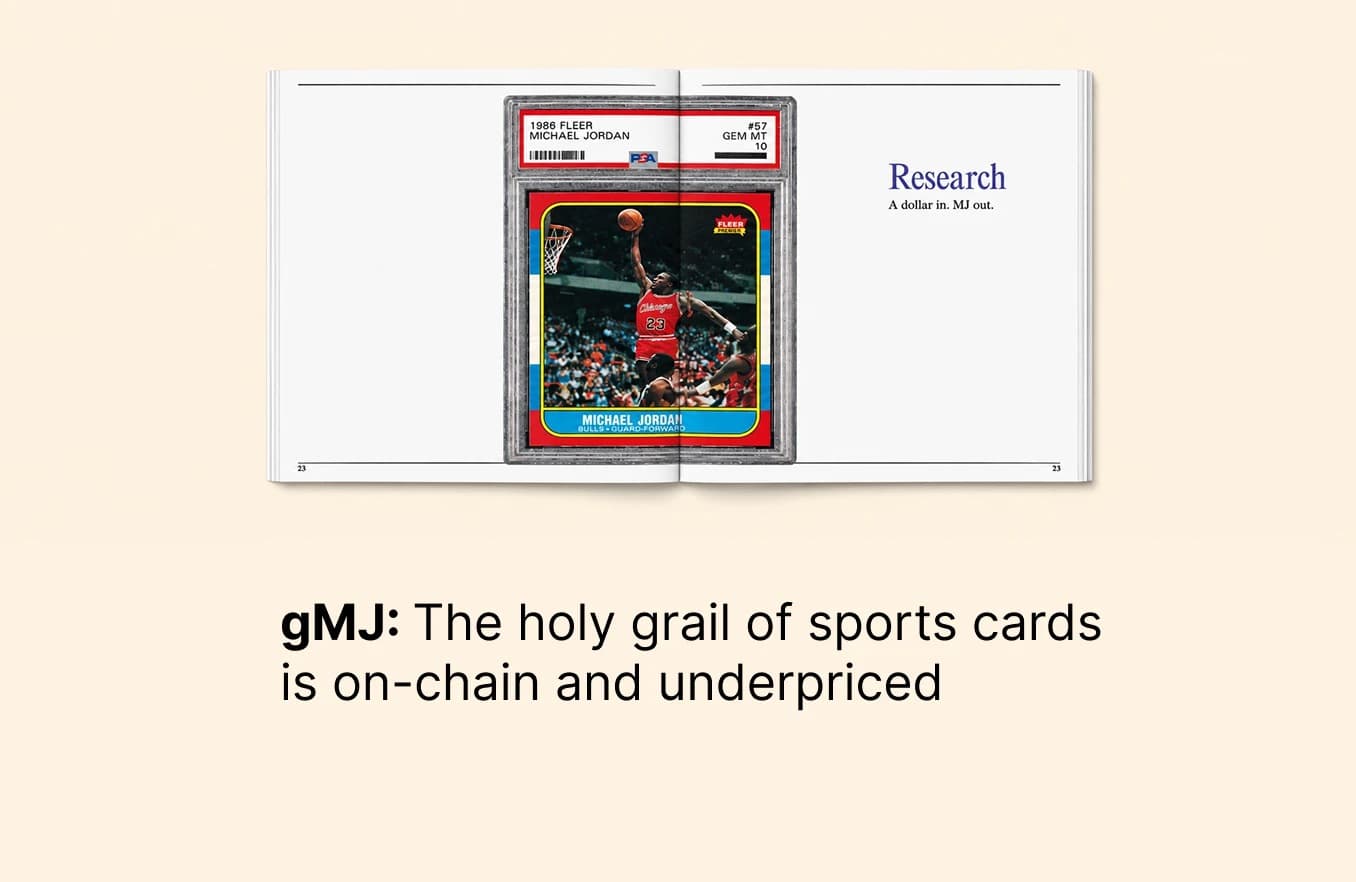
Work with us →gMJ: The holy grail of sports cards is on-chain and underpriced
The most iconic trading card ever printed now trades like a token 24 hours a day on Uniswap — and it sits at a 5–7% discount to its real-world price.
gSPEED: the first memecoin with a floor under it
Every SPEED token before this one is now worth a rounding error. gSPEED is different — each token is a fractional claim on a real, vaulted iShowSpeed PSA 10. A meme with a redemption floor.