Intro
Here's the joke in the name. Wall Street guarded a few things closely. Who gets access, what hours you can trade, the rope around who gets to hold what. A company called Robinhood just took all of that and handed it to anyone with a phone in 120 countries. Stock tokens that trade at 3am. Yield on a stablecoin. Your NVDA exposure is posted as collateral in an app that has never heard of your broker.
Steal from the gatekept, give it to the timeline. The name was always a little ironic. Now it's the whole strategy.
The launch itself isn't the part I keep thinking about though. What I keep thinking about is what it says about every other consumer product that could ride the same rail. Once you accept that the winning move is to hide the chain inside an app people already trust, the question changes. It stops being "which chain wins" and becomes "which products do you pipe through the surface once you own it." That list is longer and stranger than people think.
Own the surface and the chain is just plumbing. The real game is what you send through the pipes.
How big does "hide the chain" actually get
Let us size it the way we actually think about it, roughly, without pretending we have precision we don't. Now overlay them:
Tokenized equities give you the trillion-dollar base asset. Stablecoins give you the settlement medium normal people already understand as "dollars." Prediction markets give you the opinion layer. AI gives you a whole new class of user, one that transacts constantly and never gets bored.
Robinhood just proved you can wrap all of it in one app and hide the machinery. That's the thesis in one line.
The consumer surface that hides the chain inherits every primitive you can pipe through it.
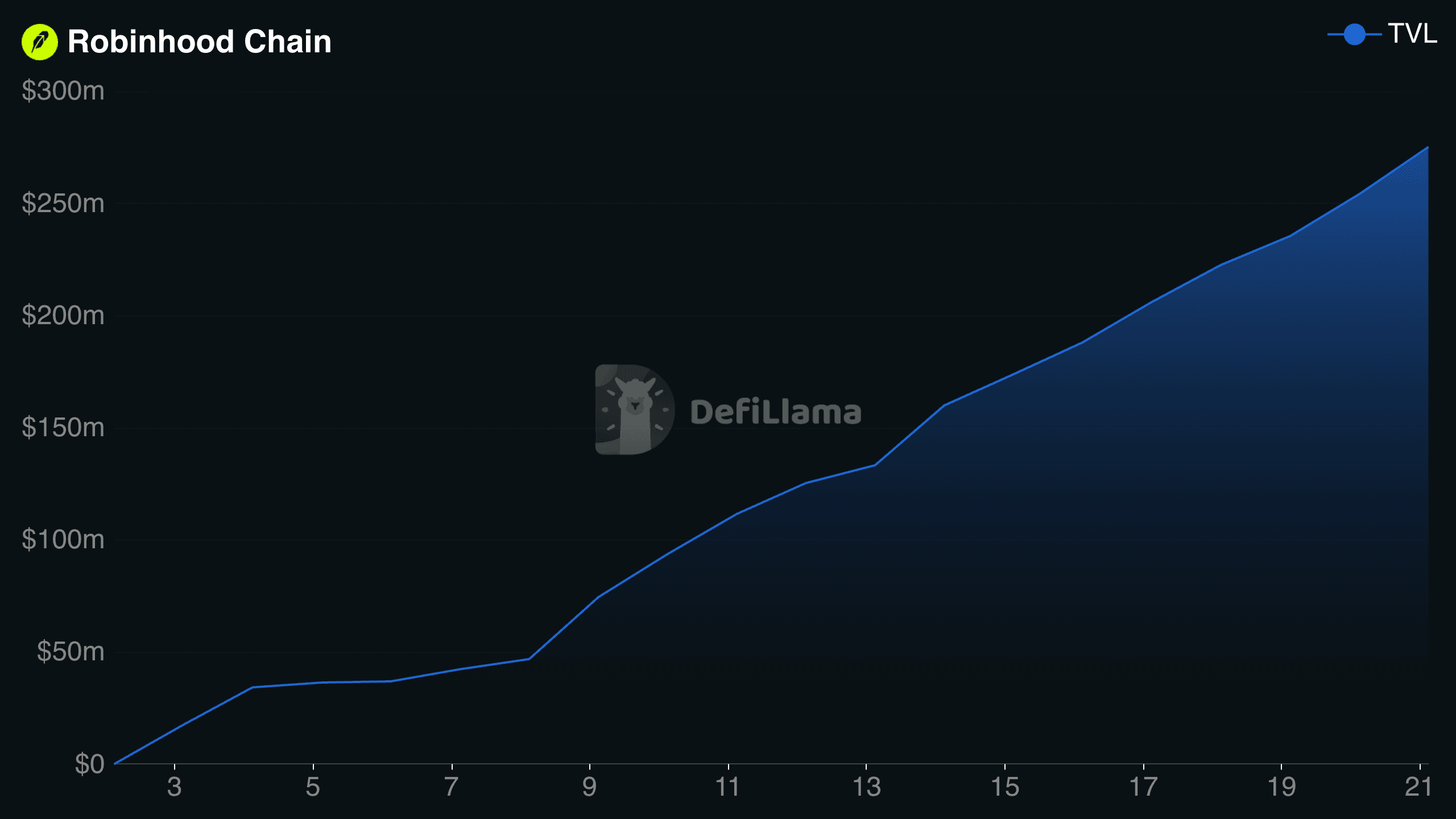
You don't have to take my word for the magnitude. Robinhood published it themselves. One 25-day window, one app, three primitives running side by side. Equities, crypto, and the opinion layer all running through one app, in a single 25-day window.
So which primitives?
Tokenized everything — stocks, then funds, then the weird stuff
Stock tokens are the wedge. The real size shows up when the same rail wraps things equities never could. Private company exposure. Sports contracts. Revenue shares. A slice of a music catalog. A fractional anything. The moment a stock is just a composable token, the category stops being "equities onchain" and becomes "any cashflow or exposure, onchain, 24/7, usable as collateral."
That's a much bigger surface than the stock market itself.
Our take: highest-certainty primitive on the board. Boring in the best way, and the winner is whoever makes it invisible, not whoever tokenizes first.
AI coins & agent economies — Virtuals, agent tokens, and the "everything is an agent" trade
Our honest read on AI coins is that the thesis is right and most of the tokens are wrong. The durable idea underneath Virtuals-style platforms is that agents become economic actors. They hold balances, pay for compute and inference, transact with each other, and need rails a human bank account can't give them. An agent can't open a Chase account but it can hold a wallet. That is the non-hype version of AI plus crypto, and it's genuinely large.
The trap is that most AI coins are a ticker stapled to a demo. The value in the real stack is moving toward compute, inference, distribution, and cost, not general-purpose model tokens. So the coins that matter long term probably look less like "AI mascot with a token" and more like infrastructure. Agent payment rails. Inference markets. Compute hedging. The boring picks and shovels of a machine economy.
Our take: long the agent-economy primitive, short the mascots. The winners solve how billions of agents pay, price, and act — not the ones with the best avatar.
Memecoins — the best consumer product crypto ever shipped
Say what you want about memecoins but pump.fun is probably the most successful crypto consumer product ever built. One-tap creation, instant liquidity, a chart that moves in seconds, viral by default. It nailed the psychology every other category keeps missing. Identity, social proof, variable reward, a $5 into $50k dream, and fast feedback. The financial primitive underneath is irrelevant to the user because the feeling is the entire product.
What Robinhood's move says about memecoins is uncomfortable but simple. The mechanic is portable. The moment a trusted consumer app copies the one-tap, chart-goes-up, share-with-friends loop and points it at a base of funded users, the degen energy stops being a crypto thing and becomes normal consumer behavior. Vlad greenlighting memecoins on the L2 wasn't a meme but a distribution decision.
Our take: stop dismissing the mechanic and start stealing it. The next breakout consumer product borrows memecoin psychology and hides the chain.
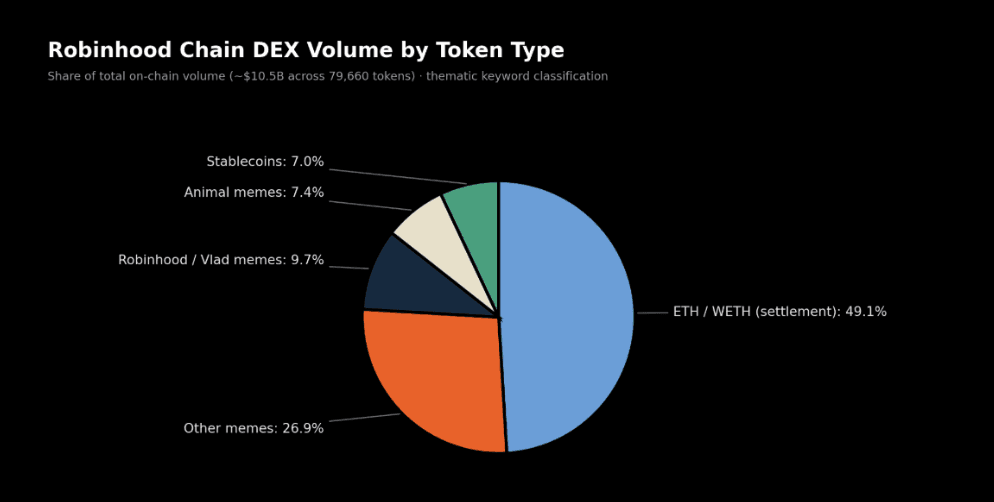
The live data on Robinhood Chain proves the point and the risk at the same time. Two weeks in, memecoins are doing most of the lifting on the chain. Artemis counted 300,000-plus daily active addresses and $300M in TVL, but its CEO Jon Ma wrote an open letter to Vlad warning that the network's biggest strength could become its biggest liability. He pointed at the 2024 memecoin class on Base, down 99% from peak. The mechanic drives the volume and the trust problem in the same breath. That's the thing builders have to hold both sides of.
Prediction markets — the most powerful primitive with the worst packaging
This is the one we think about most. The primitive is arguably more powerful than a memecoin. You're literally pricing the future, weighted by capital. And yet the experience is still "buy YES at 72¢, wait three months, feel nothing." No velocity, no chart that moves you, no reason to open it on a Tuesday.
Put it on a Robinhood-style surface and everything changes. "I have an opinion" becomes "I have a position" in one tap, for someone who's never touched a wallet. And it compounds with the other primitives. Prediction markets become the probability feed AI agents call before they act. The risk layer that tokenized-asset lending reads. The hedging tool a normal person uses without knowing it's a prediction market. The trading app is version one. The infrastructure is version two.
Our take: the primitive is generational, the packaging is cooked. Whoever makes pricing the future feel like tapping a like button wins a category the incumbents are too structured to touch.
And the demand is already showing up inside Robinhood, not just on crypto-native venues. Event contracts on the platform went from 300 million in Q1 2025 to 8.8 billion in Q1 2026, per Artemis. That's a nearly 30x jump in a year, running through an app normal people already trust. It's the clearest proof of the whole thesis. Put the opinion layer on a surface people already open and the volume follows without anyone learning the word "prediction market."
Who actually inherits the consumer
Line the four up and the pattern is obvious. Tokenized assets are the base. AI coins are the new user. Memecoins are psychology. Prediction markets are the opinion layer. Every one of them gets better the moment it lives on a surface that hides the chain and sits in front of people who already showed up.
That's why Robin da Hood is the right frame. The heist wasn't the chain. Anyone can fork a chain. The heist was the relationship. Robinhood is pointing existing trust and distribution at a stack of new primitives, and startups that spent years bootstrapping from zero are suddenly competing against a company that already has the users, the brand, and the funded accounts.
So the builder question flips. Don't ask which primitive is hottest. Ask who already owns a surface people open without thinking, and what's the one primitive you can pipe through it that they can't or won't. That's where the venture-scale outcomes live. Not in a better chain, and not in a better mascot, but in the specific primitive that a trusted surface makes feel effortless for the first time.
Steal from the gatekept, give it to the timeline. Robinhood robbed the opening bell. The next crew robs whatever's still gatekept. Private markets, insurance, credit, the future itself. And hands it to the timeline one tap at a time. That's the trade. That's the decade.
Building something interesting? We back founders shipping the next generation of crypto infrastructure.
Work with us →From Prop-AMMs to Liquidity Networks
Prop-AMMs showed that professional market-making logic can reach on-chain order flow. ElfomoFi is the live transition case toward a curator-based liquidity network.
Memecoins Need a Reputation Layer
fomo put public PnL, hold time, a trade thesis, followers, alerts and a buy button in one flow. Whether that reputation holds beyond memes is the open question.