Intro
Prop-AMMs have shown that professional market-making logic can reach on-chain order flow. The remaining constraint is the surrounding stack: capital, contracts, router integrations, settlement, and reporting are still built around each strategy.
Most Prop-AMMs are still vertically integrated. One firm supplies the model and operates the venue. That preserves control, but makes every new asset, chain and LP relationship an infrastructure project.
A liquidity-network model separates proprietary pricing and hedging from the capital, settlement, distribution, and reporting stack around a strategy. ElfomoFi is a live transition case. Its first-party strategy already combines vault capital, Prop-AMM execution, and access to fragmented EVM order flow while external curators and delegated LP allocation are the next layer.
Prop-AMMs changed the unit of competition
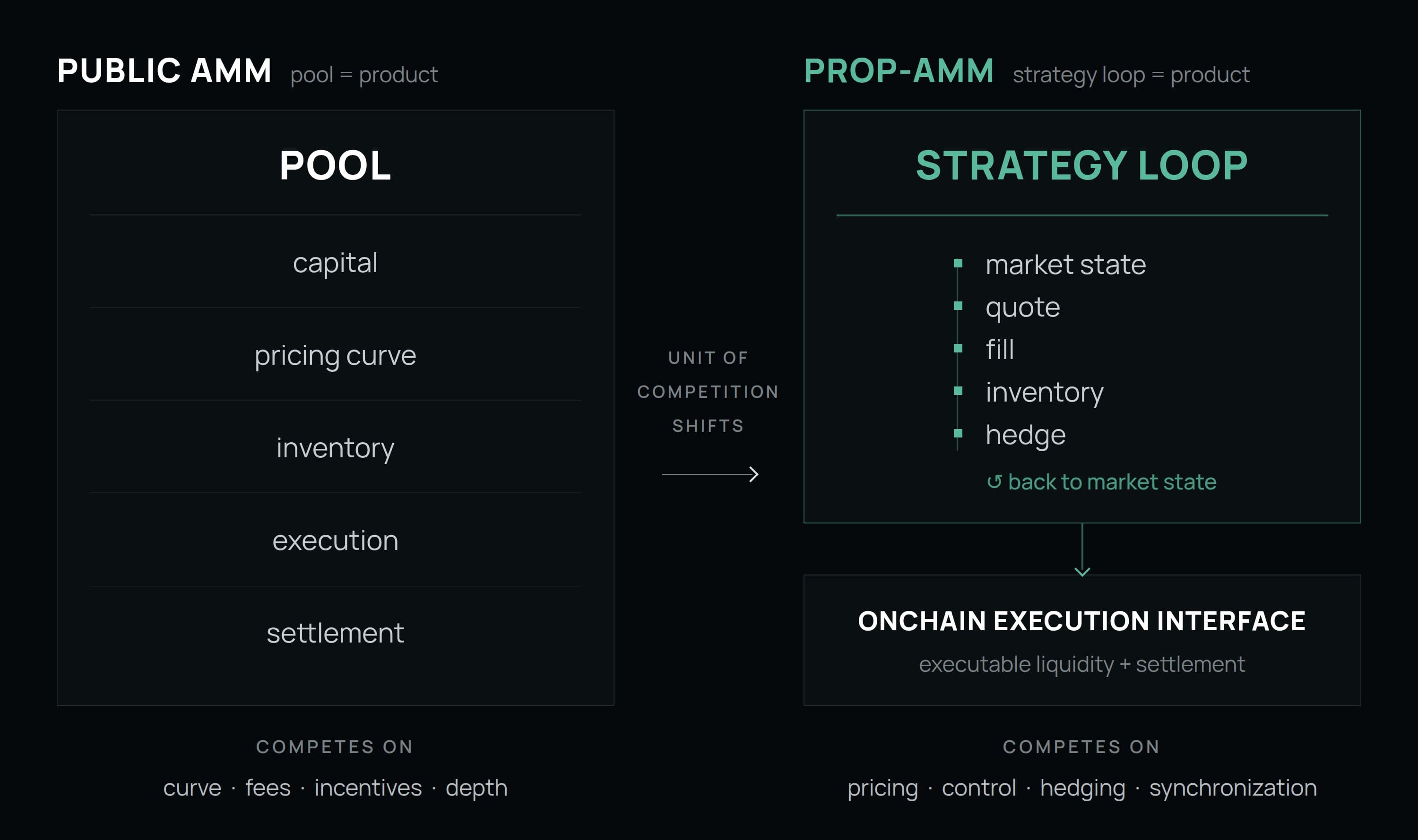
The first generation of AMMs made the pool the atomic unit of liquidity. One public pool combined capital, a pricing rule, inventory, execution, and settlement. LPs selected a pair and fee tier, routers compared pools, and arbitrageurs synchronized each pool with the wider market. Strategy existed, but much of it was embedded in the design of the venue.
Prop-AMMs break that bundle. The on-chain logic remains the surface through which liquidity becomes executable and trades settle, but the decisions behind it move into an operator-controlled loop. Fair value, inventory targets, hedge availability, and willingness to trade are no longer properties of the pool alone. The pool becomes an interface through which a market-making strategy reaches order flow.
Passive pools are differentiated mainly by their curve, fees, incentives, and available depth. Prop-AMMs are differentiated by the quality of a decision loop: market state becomes a quote; a quote becomes a fill → a fill changes inventory → inventory triggers a hedge → and the result feeds the next quote. Two venues can expose similar contracts and comparable capital yet produce very different outcomes because the scarce input is now the operator's ability to keep those states synchronized.
Portability means more than deploying the same bytecode on another chain. A strategy must continuously reconcile four environments: the external market that supplies fair value, the on-chain venue where the quote executes, the vault balance sheet that absorbs the trade, and the hedge book that neutralizes risk. Block cadence, gas costs, router behavior, fill finality, and available hedge venues can change the economics even when the pricing model is unchanged. The portable unit is the strategy behind a standardized execution interface.
Under that interface, a curator keeps its model, signals, and hedging logic proprietary and exposes only prices, available size, validity conditions, and risk limits. The platform standardizes capital custody, quote ingestion, settlement, routing, accounting, monitoring, and emergency controls.
The boundary between a venue and a network is operational. An independent market maker must be able to deploy through the same rails without surrendering its model or sharing another curator's balance-sheet risk. Whether this can be done without degrading execution is the question the rest of the article tests.
Moving to the liquidity network
Market-maker aggregation is not new. RFQ systems such as Bebop and Hashflow already connect multiple professional firms to wallets, aggregators, solvers, and applications. Bebop can split large orders across several makers and return firm prices with guaranteed fills. Their activity shows that multiple professional makers can be distributed through one DeFi integration.
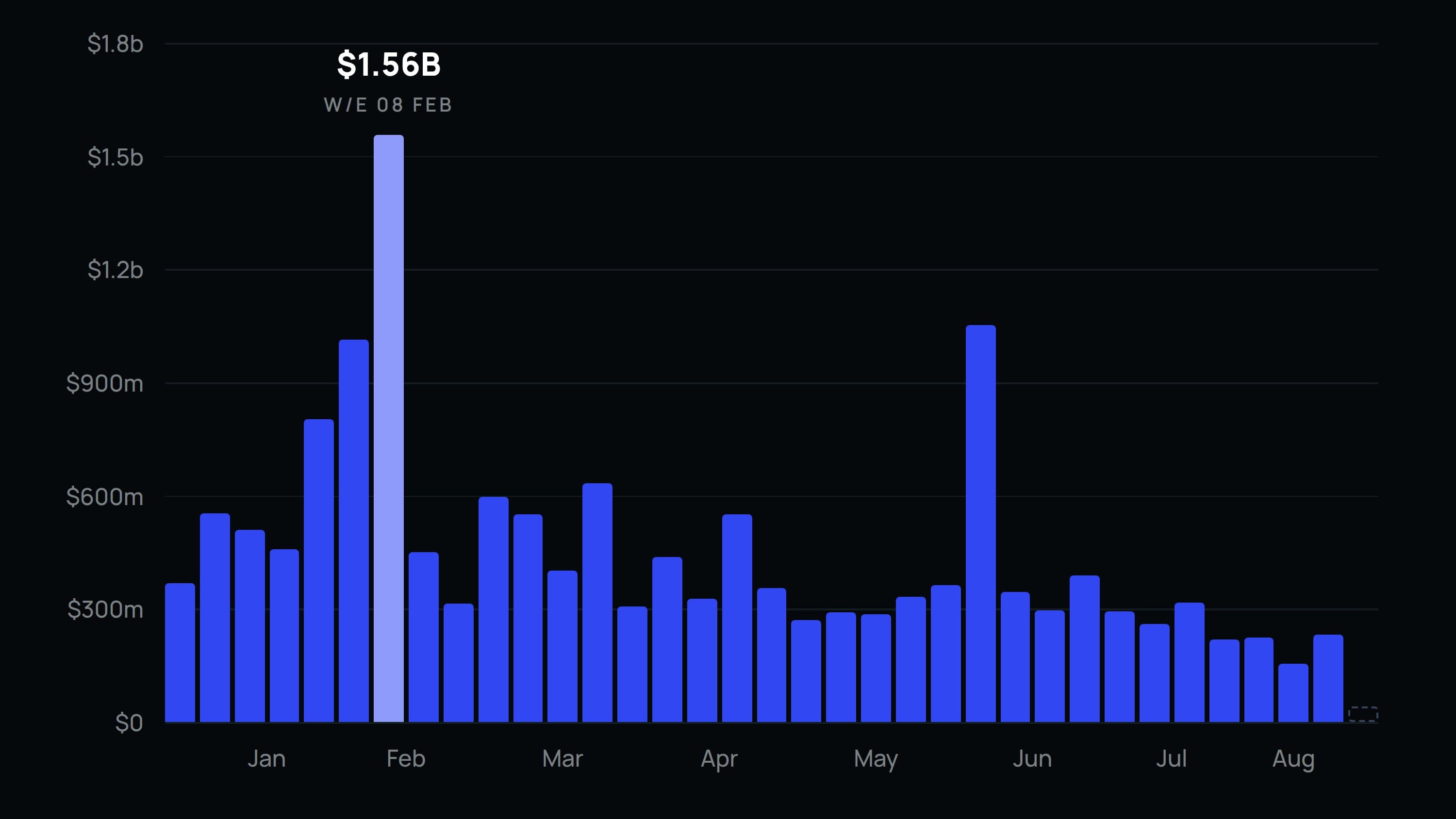
Bebop DEX Aggregator Volume. Source: DeFiLlama
In an RFQ system, a maker commits to short-lived, taker-specific quotes. This gives the taker execution certainty but leaves the maker uncertain about which outstanding quotes will fill and how those fills will affect inventory. A Prop-AMM instead exposes reusable on-chain liquidity whose parameters can change after each trade, giving the operator more direct control over pricing and inventory.
A liquidity-network design would combine RFQ-style distribution and multi-maker coordination with adaptive Prop-AMM control and settlement rules that bind execution to a valid quote.
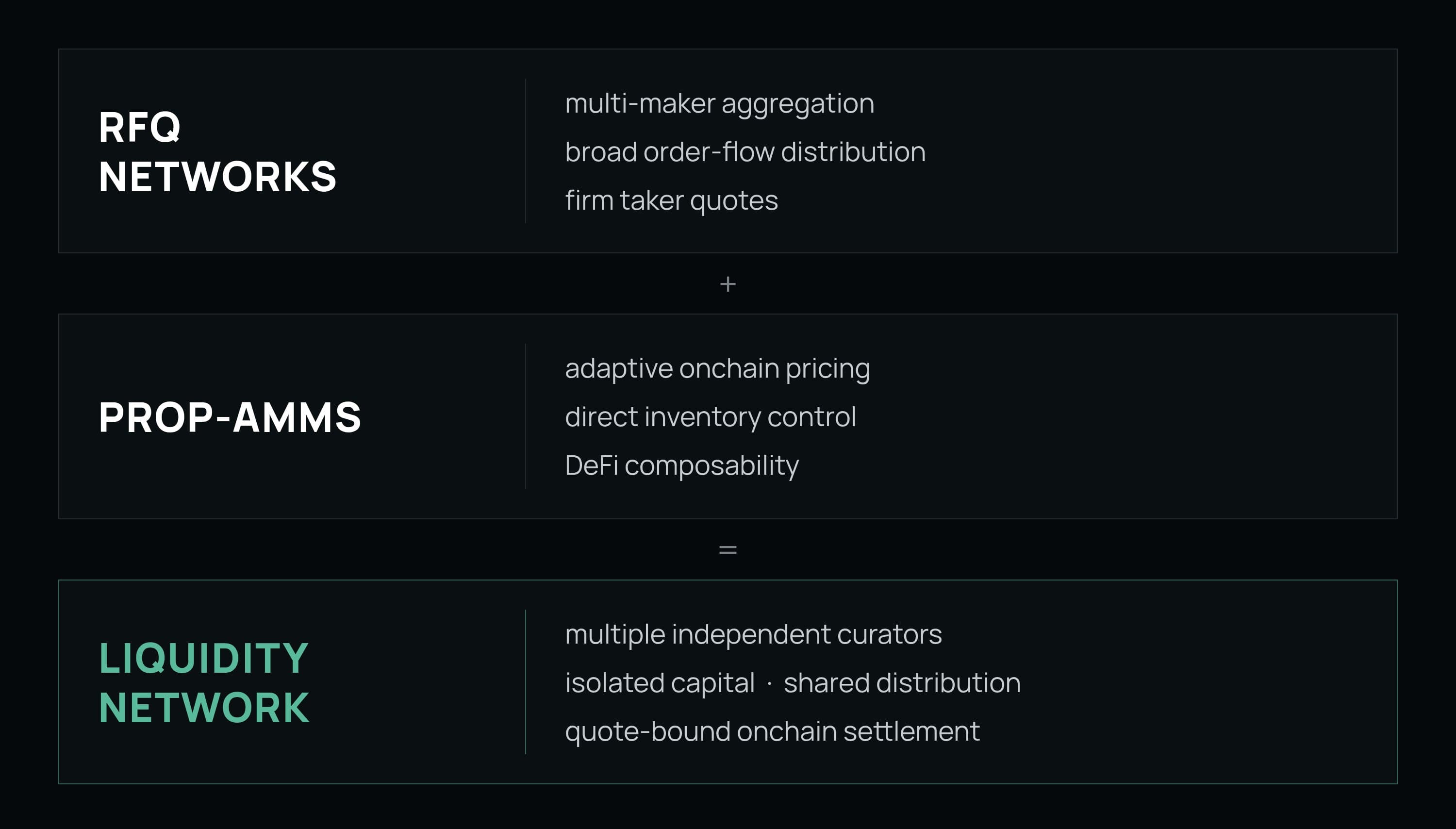
In that model, the value chain separates into five roles: LPs provide the balance sheet. Curators supply pricing, inventory and hedging logic. The platform provides vaults, permissions, settlement, data, reporting and integrations. Aggregators, solvers and wallets bring taker demand. Centralized exchanges and other liquid venues remain the hedge layer.
A trading firm can be excellent at quoting WBNB/USDT, tokenized equities or a narrow set of volatile assets without being excellent at smart-contract security, vault accounting, EVM integrations and retail distribution. An LP can provide capital without designing a pricing engine. A router can integrate one execution interface rather than negotiate separately with every desk.
The closest precedent is the curator layer in lending. Morpho separates immutable market infrastructure from vault-level risk decisions, while Euler lets external curators configure governed vaults.
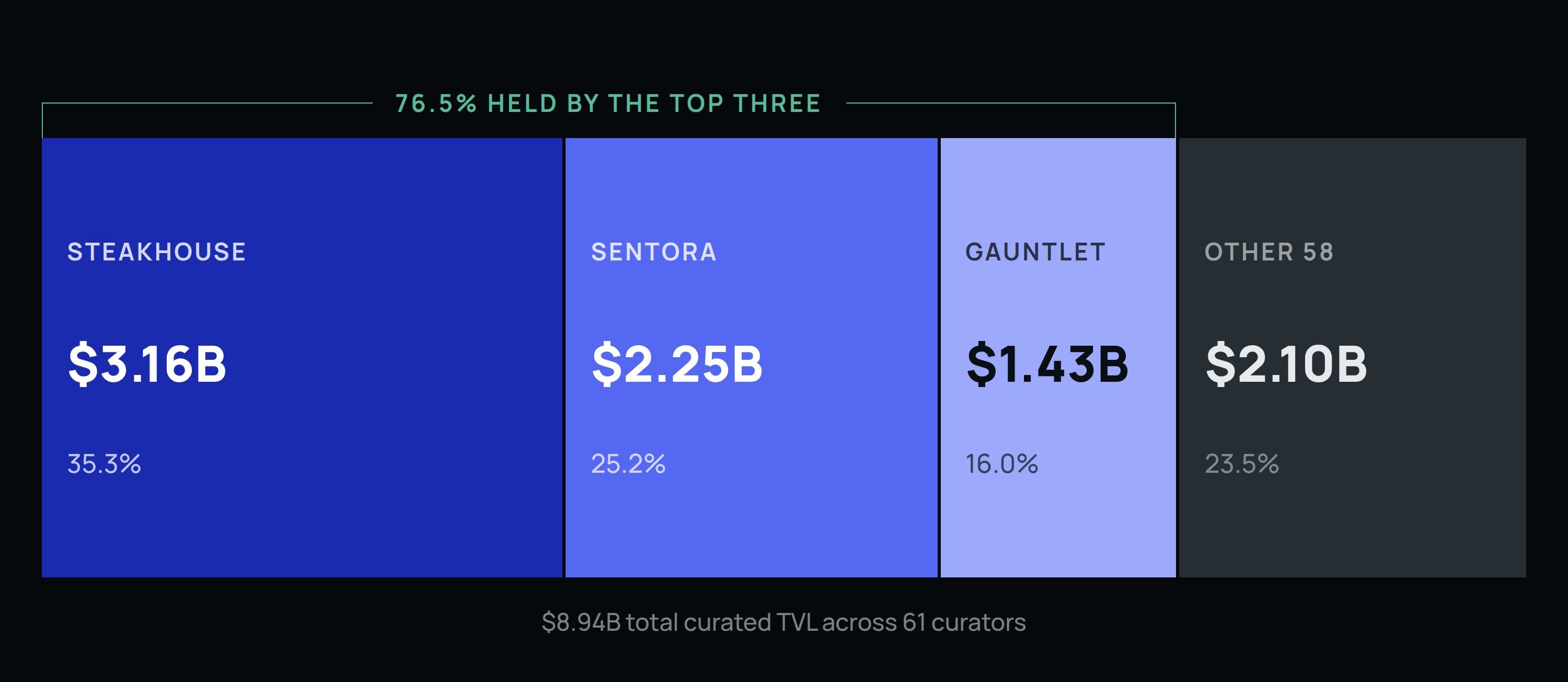
Risk Curator TVL Across DeFi. Source: Dune
Lending curators mainly decide where capital can be allocated and under what constraints. Liquidity curators also price trades continuously, so each strategy has a finite profitable capacity. A liquidity network must therefore keep allocation within that capacity and isolate curator balance sheets. If all curators share one opaque balance sheet, the platform has recreated a multi-manager trading firm rather than a marketplace. Isolated vaults, attributable PnL, and enforceable limits preserve that separation.
Why a market maker would plug in
The curator proposition is most suitable for operators that already possess a pricing edge but lack efficient on-chain distribution. This includes specialized crypto market makers focused on particular assets and CEX- or TradFi-native desks with proven pricing and hedging systems but limited smart-contract infrastructure.
Many trading firms already know how to price and hedge. Reaching fragmented EVM order flow across aggregators, solvers and routers is a separate infrastructure problem. ElfomoFi already provides that access, manages flow quality and toxic-flow reduction, supports frequent low-cost quote updates, and handles settlement and reporting. Curators can keep their models proprietary and focus on pricing and hedging.
Distribution has already become large enough to support a distinct infrastructure layer. Aggregator-routed spot volume increased from $164B in 2023 to $1.74T in 2025 — a 10.6x increase in two years. Over the past 30 days $76B of aggregator volume has been recorded, equivalent to 43.4% of the $175B of spot DEX volume it tracked over the same rolling window. Because aggregator trades settle on underlying DEXs, this ratio measures routing intensity — but these figures show that routing is one of the main channels through which liquidity is discovered and distributed.
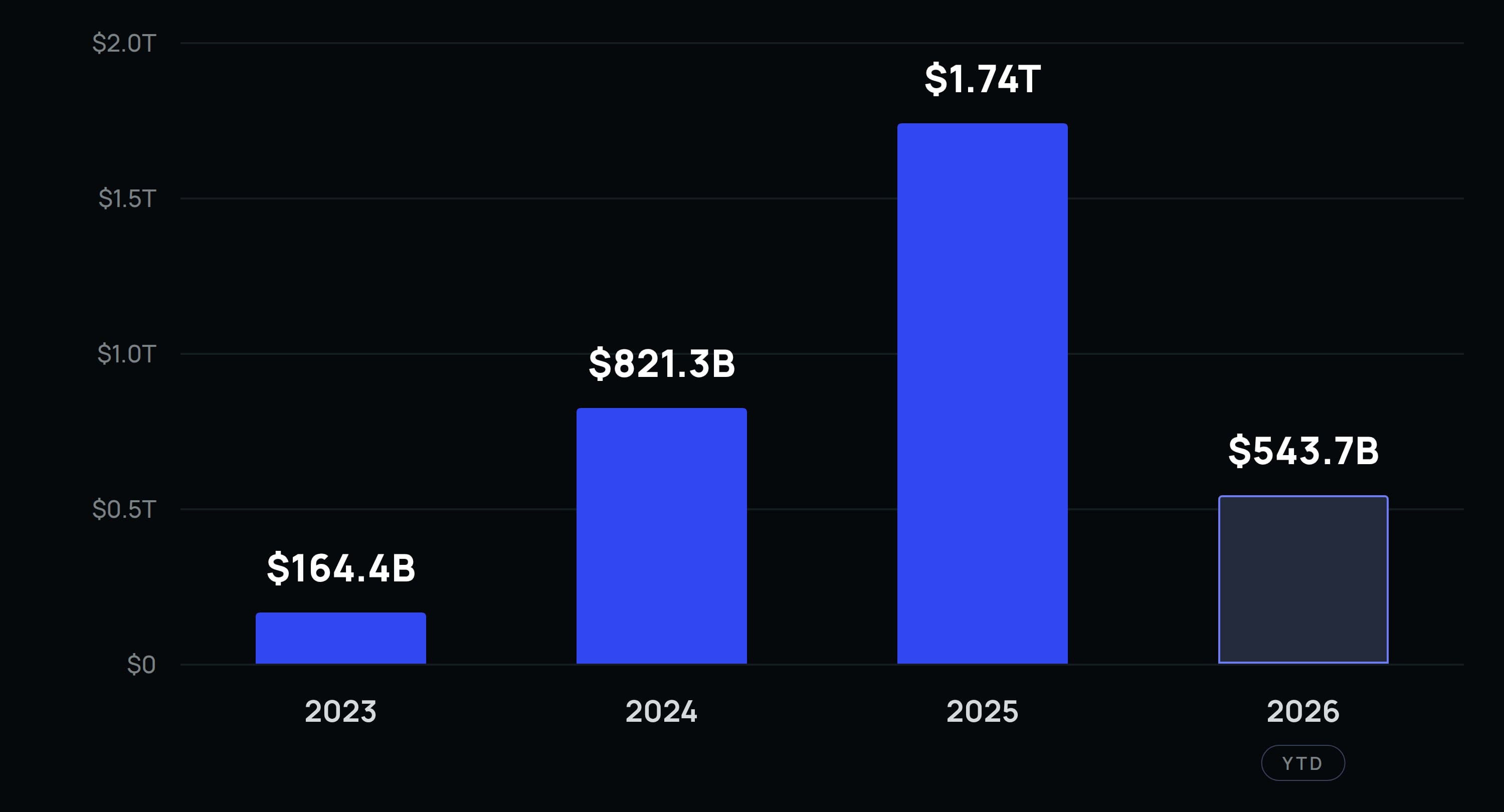
DEX Aggregator Annual Volume. Source: DeFiLlama
Building independently preserves control and the full trading spread, but requires contracts, security, vault accounting, capital sourcing, router integrations, monitoring, and chain-specific operations. A platform is attractive when faster distribution and additional capital offset the LP and protocol share, the loss of infrastructure control, and the disclosure needed for LP underwriting.
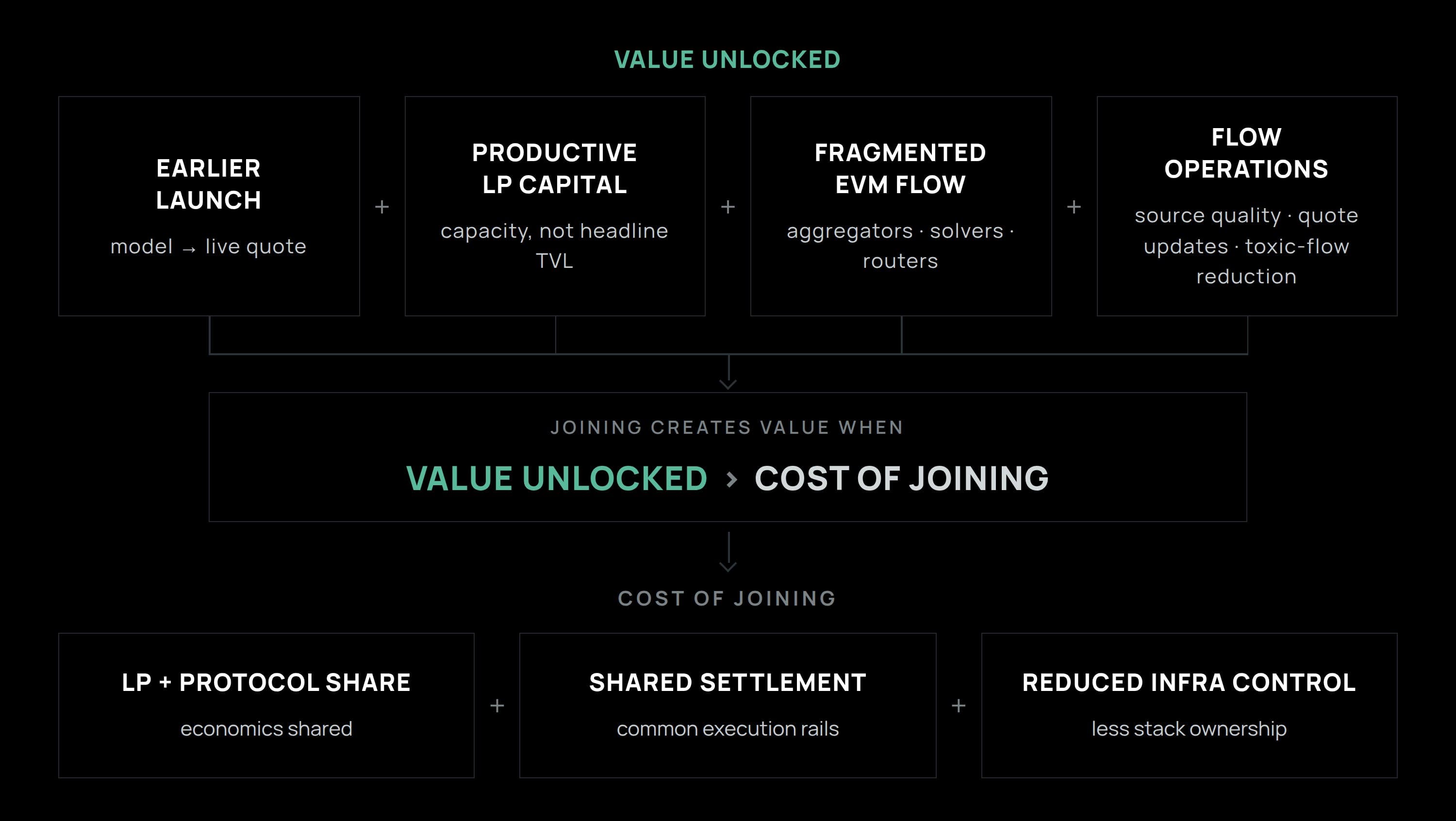
ElfomoFi as the transition case
ElfomoFi already operates most of the stack required for this transition. Its hybrid prop-AMM updates prices each block using an internal theoretical price and on-chain signals. Aggregators and solvers route trades to the contract when its quote is competitive. Users deposit into a vault, receive yield-bearing el-Tokens, and the curator deploys that capital into an actively managed strategy.
ElfomoFi reports an 11.45% cumulative gross return since launch, equivalent to roughly 41% annualized gross APY and 897X capital turnover since May 2026. The return series measures gross vault performance, while turnover measures how much execution the same capital supported. Markouts, drawdown, and net LP returns complete the performance picture.
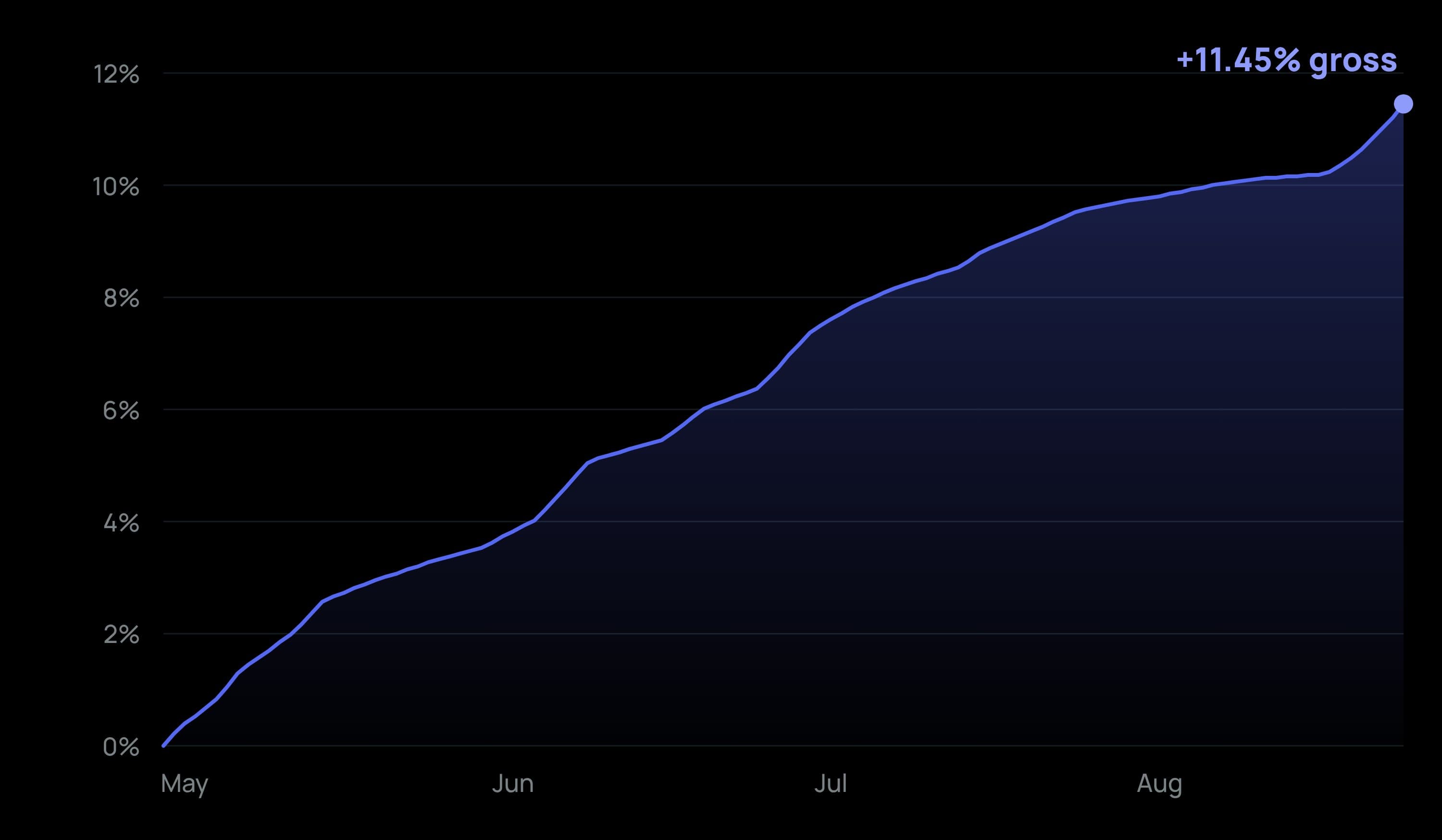
Base delta-neutral vault performance. Source: ElfomoFi
ElfomoFi has since deployed an updated version of its pricing system. Vault returns and trading volume increased across its live deployments after the release. Market-wide volumes rose over the same period, so the latest results reflect both stronger trading conditions and the updated pricing logic.
As of 24 August 2026, ElfomoFi had processed $233.5M of DEX volume over the preceding 30 days and $1.546B cumulatively. Base contributed $163.6M over 30 days and $1.388B cumulatively; BNB Smart Chain contributed $69.9M over 30 days, or 29.9% of the total, and approximately $157.4M cumulatively. Following the Fermi upgrade, BNB Smart Chain runs at roughly 450ms block intervals, supporting frequent price refreshes. Elfomo's published BNB Chain markets include WBNB/USDT, BTC/USDT, ASTER/USDT, and bSTOCKS markets. The deployment provides a live test of whether the strategy and execution stack can remain effective outside Base across a broader set of hedgeable and higher-volatility assets.
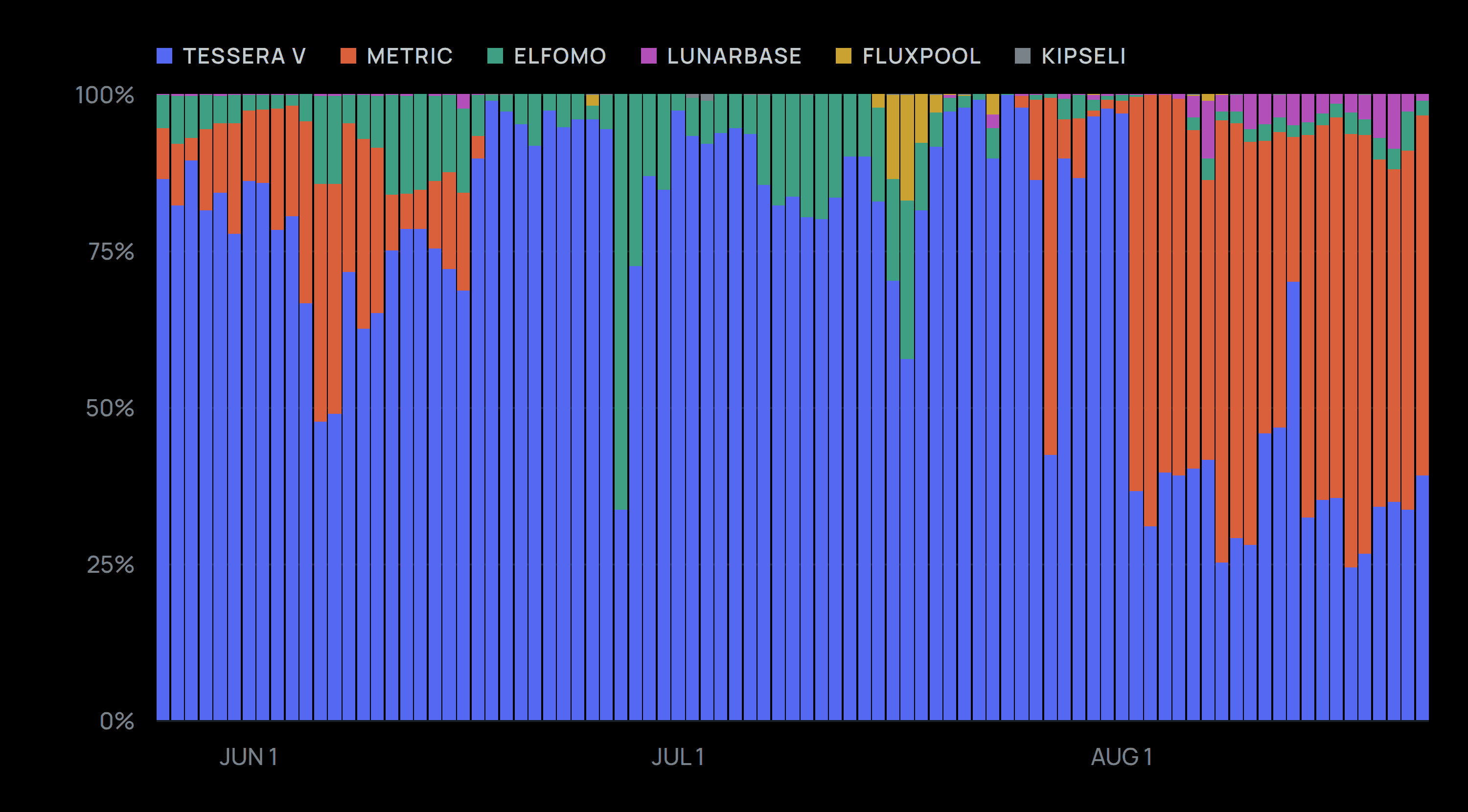
BNB Chain Daily Prop-AMM Volume Share by Protocol. Source: Dune
The BNB Chain series provides the cleanest direct peer comparison because it holds the chain and denominator constant. It tracks six Prop-AMMs and shows how daily market share rotates between operators.
ElfomoFi continues to receive order flow from aggregators and solvers as market share moves between Prop-AMMs. Vault TVL stood at approximately $600k on Base and $300k on BNB Smart Chain. BSC market share should therefore be read against a capital base roughly half the size of Base's, alongside differences in pricing and hedge capacity. External market makers could expand those capabilities over the same distribution rails.
ElfomoFi's proposed multi-curator model separates proprietary strategy from the operating rails around it. Curators would supply pricing, inventory, and hedging logic; ElfomoFi would provide vault infrastructure, capital access, connectivity across aggregators, solvers, and routers, frequent quote updates, flow-quality controls, on-chain settlement, and reporting. LPs would either allocate directly to a curator-specific vault or delegate allocation across strategies, vaults, and chains through the planned autopilot. Vault-level accounting would remain isolated under both routes, preserving strategy-level PnL attribution. Profit shares and the protocol share would be configured at the vault level.
Under the planned model, each curator vault contributes executable quotes and available size to a combined order book. Orders at the same price level would be filled pro rata according to quote size. The settlement layer would bind execution to the quote parameters supplied to the router, subject to the quote's validity conditions. Curators would also receive performance and flow data to adjust their quoting.
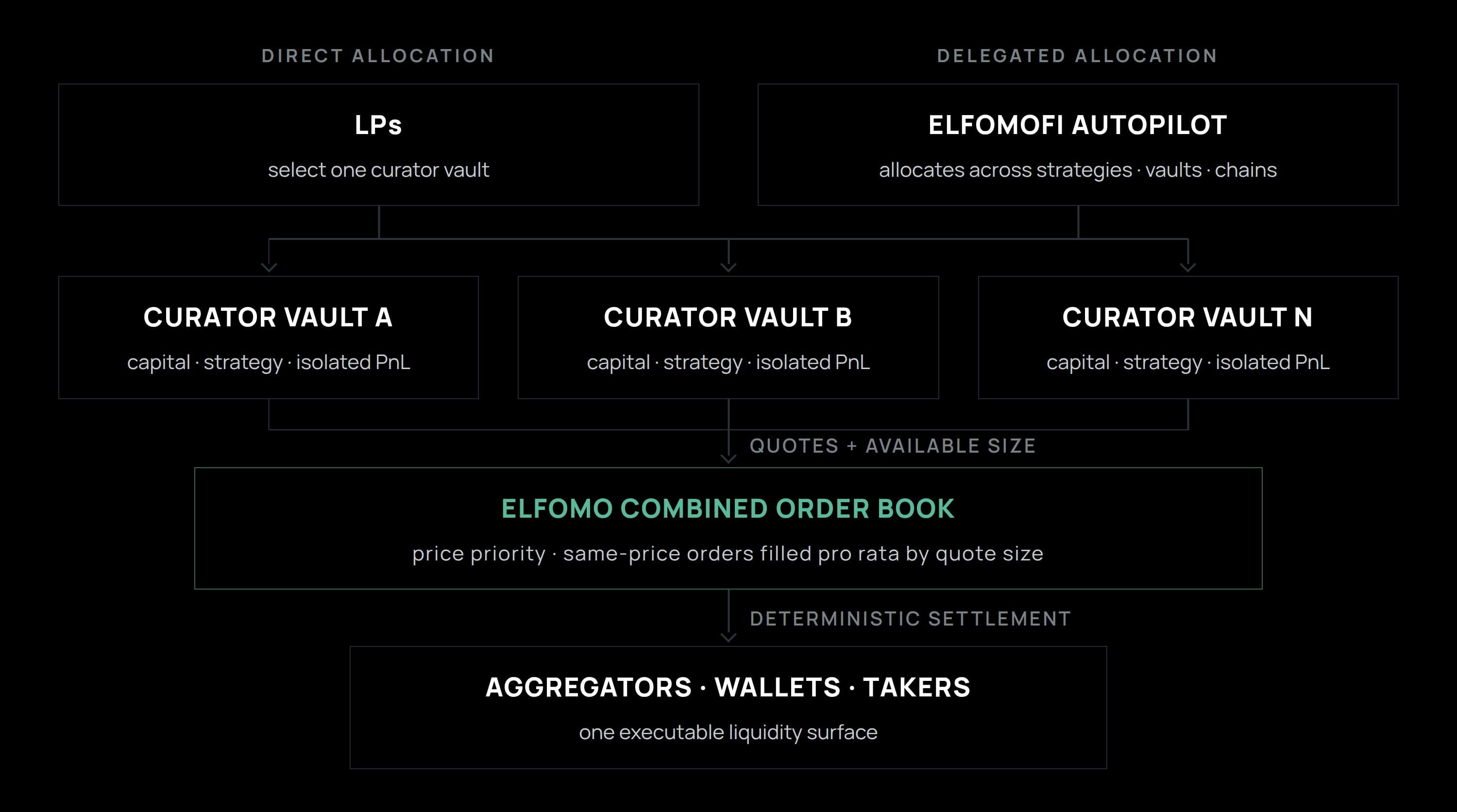
ElfomoFi proposed architecture. Source: ElfomoFi
Isolated vaults would keep capital and strategy PnL separate, while the combined book would make curator quotes compete at the execution layer. The design aims to preserve adaptive maker control while binding execution to defined quote-validity conditions.
What the model still needs to prove
ElfomoFi already has the main components needed to support external market makers: routed EVM order flow, vault infrastructure, shared settlement, and a live first-party operating history. The next step is to show that these components can support multiple independent strategies on the same platform.
Risk isolation is the first test. Curator-specific vaults should contain strategy-level gains and losses, allowing LPs to underwrite a particular operator without absorbing another curator's trading losses. The boundary is not absolute: settlement contracts, oracle infrastructure, routing integrations, and reporting remain shared. The platform therefore needs to distinguish failures contained within a vault from failures that can propagate through the common rails.
For LPs, access to market-making yield also means exposure to strategy, smart-contract, oracle, execution, liquidity, and curator risk. Vault isolation limits cross-curator contagion but does not protect the principal inside a vault.
Capital allocation creates a different challenge. Direct vaults let LPs back a specific curator, while the planned autopilot serves depositors who do not want to select and monitor strategies themselves. The autopilot would allocate capital across vaults and chains over successive epochs, targeting higher expected net LP returns within strategy capacity and risk limits. The allocation decision would combine net LP return with drawdown, available capacity, turnover, liquidity conditions, and the sources of PnL. This allows the autopilot to distinguish a strategy with strong historical performance from one that can still deploy additional capital profitably.
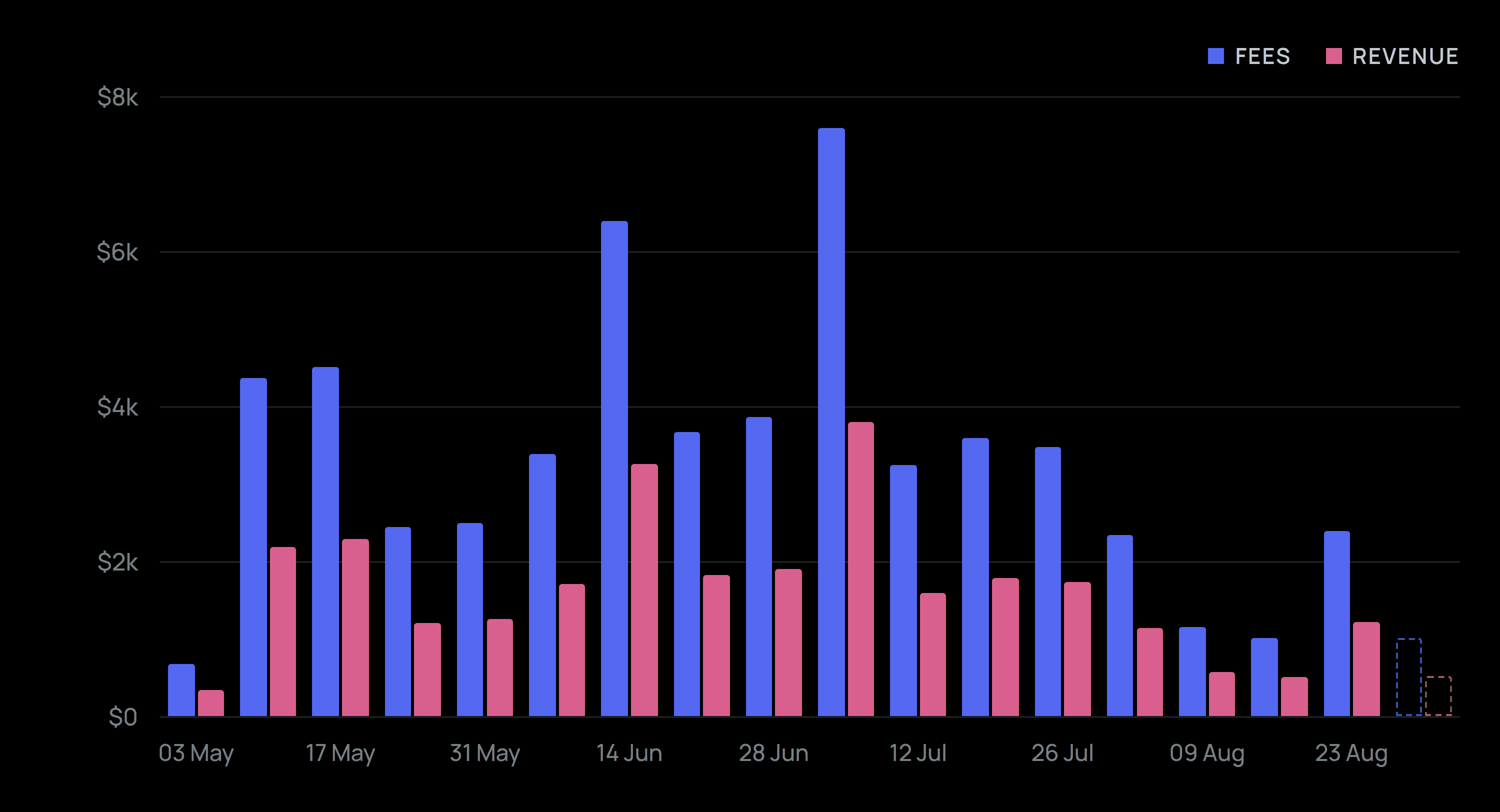
Elfomo generated $7,728 of fees and $3,858 of protocol revenue over 30 days. If depositors select on headline APY alone, capital can crowd into a strategy after its opportunity has saturated. Net LP return, drawdown, capacity, turnover, the sources of PnL, and deployed inventory should be assessed together; neither headline APY nor TVL is sufficient on its own. Elfomo weekly fees & protocol revenue. Source: DeFiLlama
Execution quality requires separate governance. A combined order book should force curators to compete on price and depth, while shared settlement should reduce discrepancies between the quote shown to a router and the execution ultimately delivered. The relevant metrics are realized output versus quoted output, revert rate, fill latency, post-trade markout, source availability, and performance during volatility. Without them, a network can optimize what the router sees rather than what the user receives.
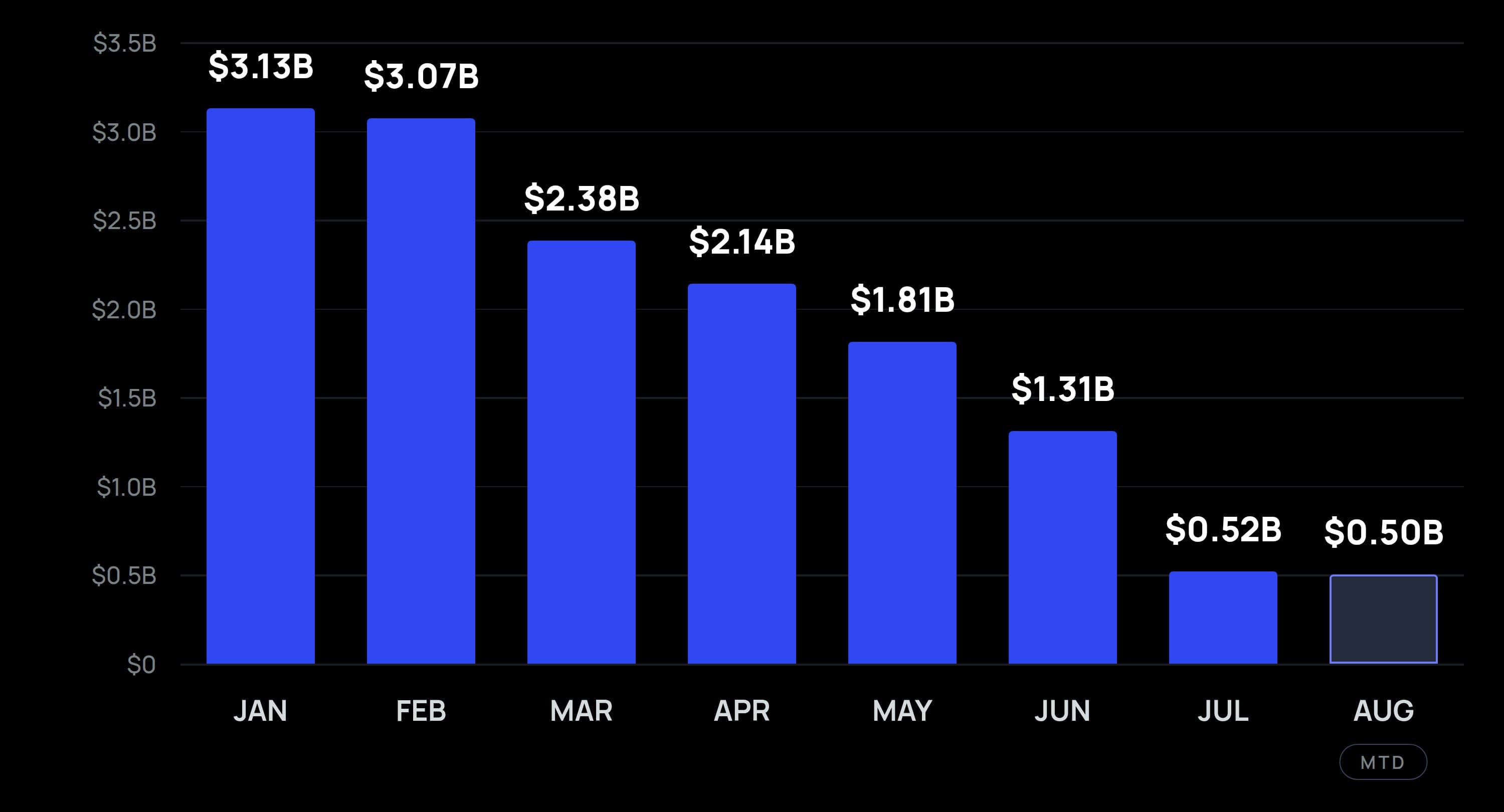
Native is the closest architectural comparator, but not an identical product. Native combines a sovereign on-chain CLOB with institutional access through Native Pro, distribution through Native Relay, and LP capital through Native Pool. It generates $599M of 30-day DEX volume, $23M of TVL, and $12M of active loans. Ethereum contributed 55.6% of monthly volume, BNB Chain 34.9%, and the remaining 9.4% came from Arbitrum, Base, Robinhood Chain, and X Layer. Native Monthly DEX Volume. Source: DeFiLlama
The relevant test is whether an external curator improves the consolidated book while remaining economically isolated from other vaults. If it does, ElfomoFi will have moved from reusable infrastructure toward a network in which each new strategy improves the shared liquidity surface.
Where the moat moves
The pricing engine remains the curator's edge. A trading firm wins by estimating fair value, managing inventory and hedging efficiently. Shared infrastructure does not commoditize those skills; it makes them deployable. Shared infrastructure is not economically neutral. When curators compete over a few basis points, flow quality, quote-update latency and cost, order-priority rules, and settlement reliability can materially affect realized performance.
The platform's moat moves elsewhere. It comes from attracting credible operators, connecting them to fragmented EVM order flow, managing source quality, supplying strategy-appropriate capital, and providing frequent quote updates, reliable settlement, risk isolation, and attributable reporting. Each fill, markout, and inventory response can improve the platform's estimates of source quality, toxic flow, and curator execution.
A liquidity network only compounds when each additional curator improves pricing, depth, asset coverage, or reachable flow without weakening LP returns or spreading losses across vaults. Curator count alone is not a moat.
In this model, Prop-AMMs become strategy modules rather than vertically integrated venues. Pricing and hedging remain proprietary, while vault infrastructure, routing, settlement, reporting, and distribution become shared rails. ElfomoFi already operates the first-party version. The network thesis will be proven only when external curators can improve the consolidated book without pooling their balance-sheet risk.
Building something interesting? We back founders shipping the next generation of crypto infrastructure.
Work with us →Memecoins Need a Reputation Layer
fomo put public PnL, hold time, a trade thesis, followers, alerts and a buy button in one flow. Whether that reputation holds beyond memes is the open question.

What a Trader Should Actually Check Before Trusting an Exchange
Four things worth checking in any exchange before trusting it with size — none of which show up on a pitch deck.