Intro
No, Papertrade is a "casino" that pays its losers in casino shares. The shares are real, but they don't refund the loss.
5 things to know before launch:
1. There are no conventional trading fees on position size. The house takes its cut from winning trades instead, through a haircut and a 2% fee. On a 0.1% move it keeps 28% of your profit. It never keeps less than about 12%.
2. The cash register starts empty. Early winners get an IOU, not cash, and wait in line until someone else loses.
3. PAPER mints at a flat 100 per $1 lost (about 98 on a normal losing close, after the 2% fee) until the LP hits $2M, and barely slows after that. Fighting for the first block buys you nothing.
4. Hedgers pay about 8x less per PAPER than degens. Open a long and a short, let one side lose, keep most of the other.
5. Before the LP passes $5M, stakers only get half of the 2% fee, and only while the IOU queue is empty. After $5M, every new dollar the house wins goes to them as well.
A casino that pays you to lose
Papertrade is a perp exchange on Hyperliquid, built by @izebel_eth and @blurr. It offers up to 1000x on BTC and ETH with no fee on position size, no funding and no slippage. Nothing you do on Papertrade touches a real order book. When you open a trade, the contract reads the mid-price of the HL book, halfway between the best bid and the best ask, and writes it down. When you close, it reads the mid again. The difference is your profit or loss, and it settles against a single pool of money called the LP. So you aren't trading against other traders. You are literally betting against the house, at prices taken from someone else's scoreboard. Your size never moves a book so there is no slippage. There is no real perp to keep in line with the spot so there is no funding.
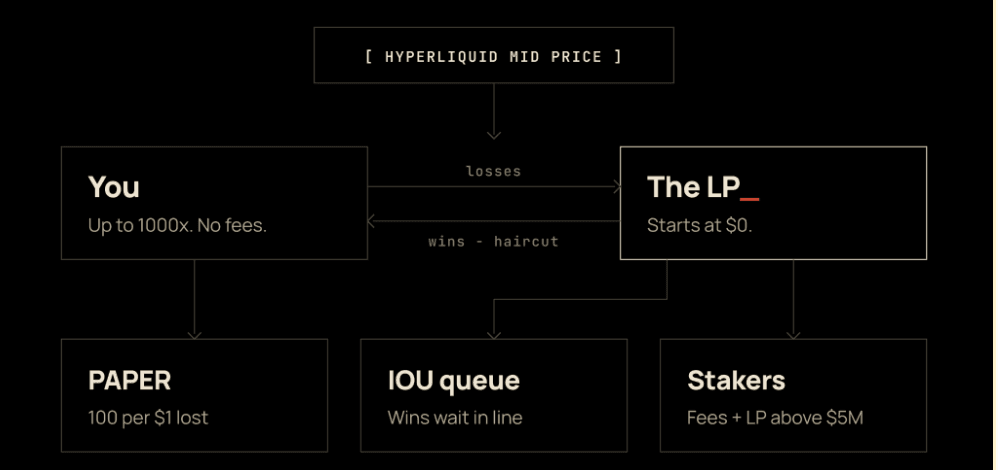
Two details set it apart from every other house-versus-player venue: (1) the LP starts at $0 — no team money, no VC money, and nobody is allowed to deposit into it — and (2) losers get paid in PAPER: every $1 you lose mints you 100 PAPER, a claim on the house's future income. The rest of this piece is about what that ownership is worth, and who ends up paying for it.
Where the house makes money
No fees doesn't mean free. Papertrade takes its cut in one place only — your winning trades. When you close in profit, three things happen to your gain:
1. A dead zone — the first 0.002% of the price move doesn't count.
2. The haircut — what's left gets multiplied by a number between 0 and 0.9. The smaller the price move, the smaller the number. Position size doesn't matter, only how far the price went.
3. A 2% fee on whatever survives step 2.
Losing trades pay nothing extra. You lose exactly what the price move says you lose.
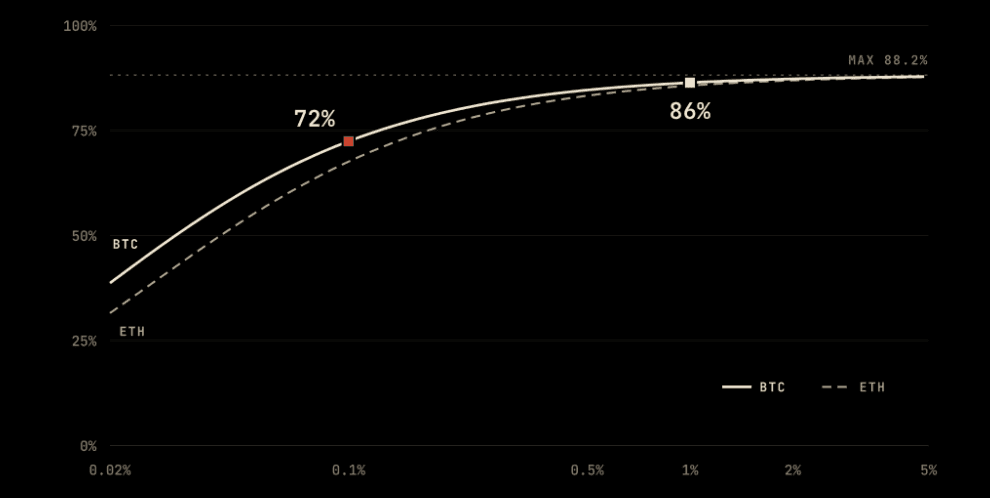
Example: $100 margin at 100x, BTC goes up 1%. Your raw profit is $100. You receive $86.38. The LP keeps $11.85, and $1.76 goes to fees.
Why build it this way? The house needs an edge, and taking it from wins is the only way that works at 1000x. A fee on notional would eat a 1000x trader alive, and a spread would be meaningless. The curve is steepest on tiny moves on purpose. Bots that see Binance move a few milliseconds before Hyperliquid, or nudge Hyperliquid's book by a tick, can only score tiny wins, and the haircut takes most of them. The papertrade's own docs say this makes manipulation harder, but not impossible.
The hard bust
The second edge is the liquidation rule. Every position has a liquidation price set about 0.05% before your margin would actually hit zero. Touch it and you lose all of your margin, even if closing a second earlier would have saved some. At 10x that buffer costs you 0.5% of your margin. At 1000x it costs you about half: liquidation fires after a 0.052% move, while a manual close at that moment would still return nearly 50% of your margin.
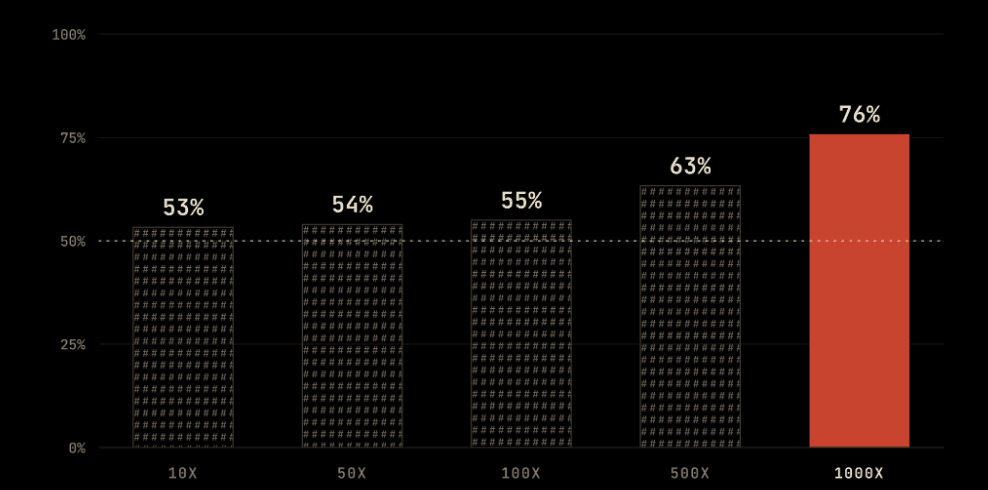
Put the haircut and the hard bust together and you get the real odds. Suppose every trade ends with price traveling the full distance to your liquidation level, up or down. How often do you need to call the direction right just to break even? At 1000x a coin flip loses badly. You need to be right three times out of four. A move up pays you about $32, the same move down takes all $100. That gap is the engine that fills the cash register.
The empty cash register
On day one the LP holds $0. So what happens when the first trader wins? They get an IOU. The win goes into a queue — bigger notional exits first. Every loss that follows pays down the front of that line. Nobody can cut in, so while anyone is waiting, the LP pays no new winner directly, even if it has cash. Your margin never waits in line. Only the profit does.
A quick walk-through:
1. The LP is at $0. Trader A wins $1,000. A's margin comes back right away, and the $980 profit left after the 2% fee goes into the queue.
2. Trader B loses $3,000. That money pays A in full, and the other $2,020 stays in the LP.
3. Trader C wins $490. The queue is empty and the LP has cash, so C gets paid on the spot.
4. Trader D wins $50,000. The LP pays out $1,500 it has and queues the other ~$48,000. Everyone who wins after D now waits behind D.
The team calls this the Martingaler mechanism. Older on-chain casinos needed someone to seed the bankroll first. Papertrade skips that step by letting the house be broken for a while and paying winners in order as losers show up.
The docs leave three things out. There's no deadline. Your IOU gets paid only when enough other people lose, and if traders stop showing up, it may never get paid at all. There's no early exit either. The whitepaper describes an escape hatch for stuck winners, but Papertrade didn't ship it. And waiting earns you no interest. You can use a queued balance as margin for new trades, but you can't withdraw it.
Two LP levels matter for everything that follows. Below $2M, PAPER mints at the maximum rate. $5M is the LP's ceiling, and above it the house stops keeping its winnings and pays them out to PAPER stakers.
The mint rate barely moves
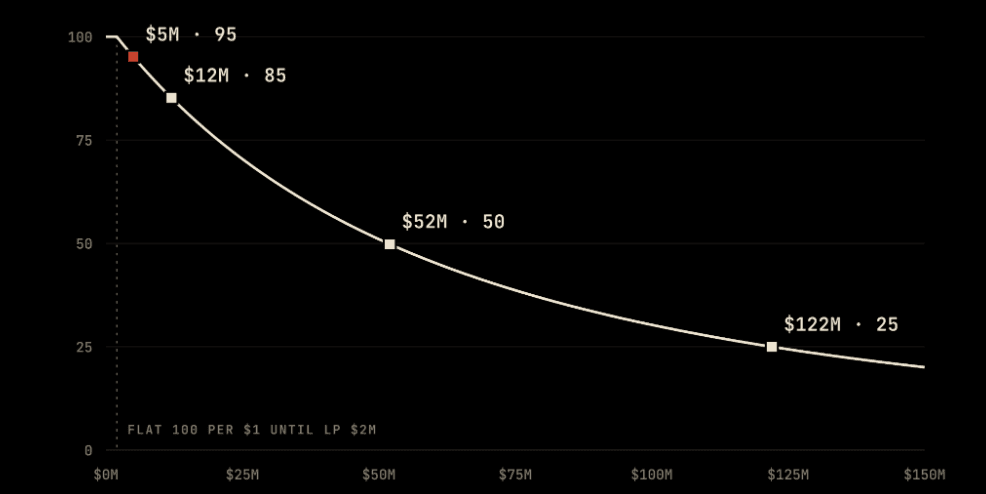
Until the LP has made $2M, every $1 lost mints 100 PAPER. That is the base rate. Close a losing trade while the IOU queue is empty and 2% of the loss goes to fees first, so you actually get about 98 PAPER per $1. Liquidations, and losses while the queue is open, mint the full 100. The examples below use 98.
After that the rate follows a formula: 100 × (120M ÷ (120M + H))², where H is how much the LP has earned past $2M. That formula falls slowly. When the LP has made $5M, a dollar still mints 95 PAPER. At $12M it mints 85. The rate only halves once the house has earned $52M.
There is no cliff at $2M and the cheap-PAPER window is wide. One more rule: if the LP falls back under $2M — for example after a whale wins big — the rate snaps back to 100 until it recovers. LP drawdowns are cheap-mint windows.
What staking pays
Staked PAPER earns USDC from two places:
1. Half of every 2% fee. The other half goes to the team.
2. Everything the LP earns above $5M.
The second source is where the money actually is. Take a day with $500k of losing trades and $500k of winning ones. Stakers get roughly $9k from fees.
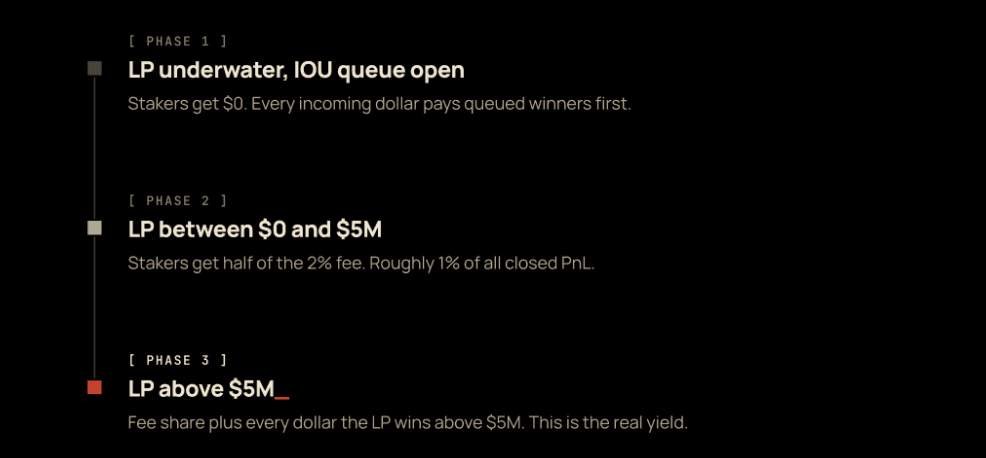
Fees only reach stakers while the IOU queue is empty. On launch day the LP is empty, so the queue will almost certainly be open, and staking yield in the first hours is zero. There's no lockup, no cooldown and no boost. Every staked PAPER earns the same, unstaked PAPER earns nothing, so stake everything as soon as you get it.
PAPER for 8x less
This is the part most degens will miss. The protocol judges every position on its own. It doesn't know, or care, that you hold the opposite trade at the same moment. So you open both.
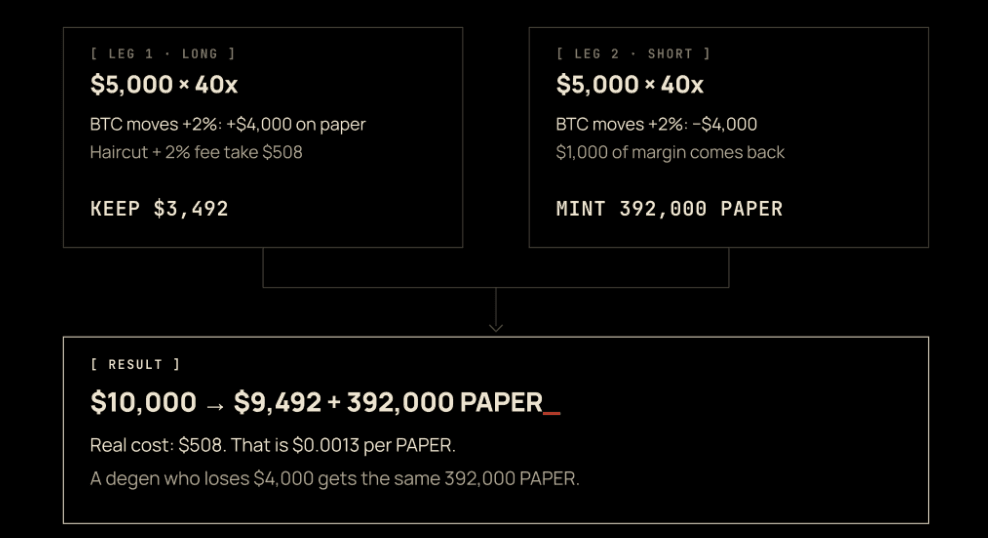
You put in $10,000 and walk away with $9,492 plus 392,000 PAPER. Your only real cost is the haircut on the winning side. A degen who simply loses $4,000 on one trade gets exactly the same PAPER. What one PAPER costs you depends on how far you let price run before you close:
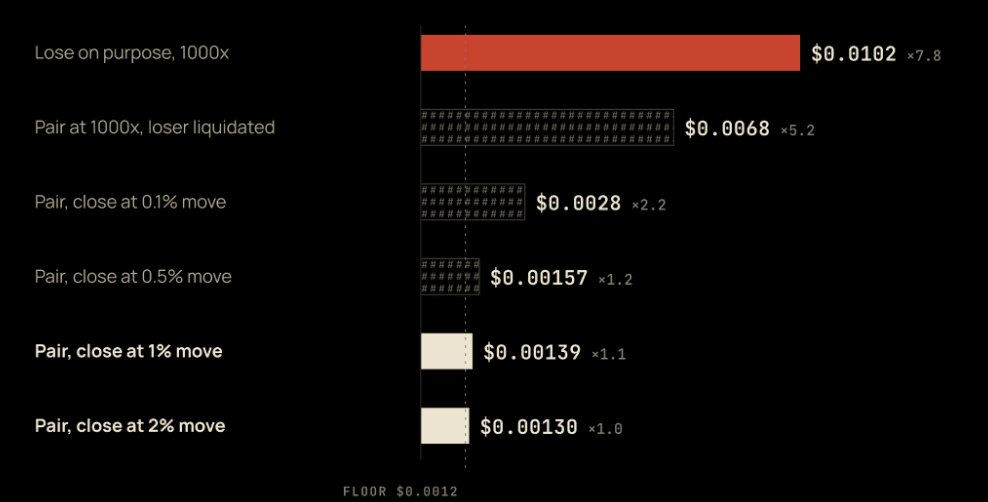
There's a hard floor of about $0.0012 on what one PAPER can cost to make, because the house always keeps at least ~12% of a win and no strategy gets around that. The sweet spot is closing at a 1% move. It costs about 7% more than waiting for 2%, but on average you get there four times faster. At 1000x, don't let the losing leg get liquidated. That pushes your cost to $0.0068 per PAPER, five times worse than a clean close. And moving the second leg to Hyperliquid doesn't buy you anything. The expected haircut stays the same, and the only thing that changes is funding.
None of this is secret. PaperStrategy's docs describe this exact method, and it has already $780k+ sitting in Papertrade accounts. Papertrade's docs don't forbid it either. Farmers aren't free riders, since every hedged cycle pays the haircut into the LP and fees to stakers. What they do is dilute everyone else's PAPER.
Where farmers actually get hurt is execution. The two legs are two separate trades, and each side of a market can only take on about $5M of new positions at a time. So one leg can go through while the other bounces off that cap, and you end up holding a naked 40x bet. Check both legs every time. The queue is the other trap. If the LP is underwater, the winning leg's profit becomes an IOU, so your spendable balance drops by the full $4,000 loss each cycle, not by the $508 you actually burned. Size your deposit with that in mind.
What is PAPER actually worth?
There's no market price yet, because PAPER can't be traded. There are still five useful reference points. They measure different things, from what PAPER costs to make, to a rough model of what it earns, to what speculators pay for exposure today. Treat them as anchors, not predictions of where PAPER will trade.
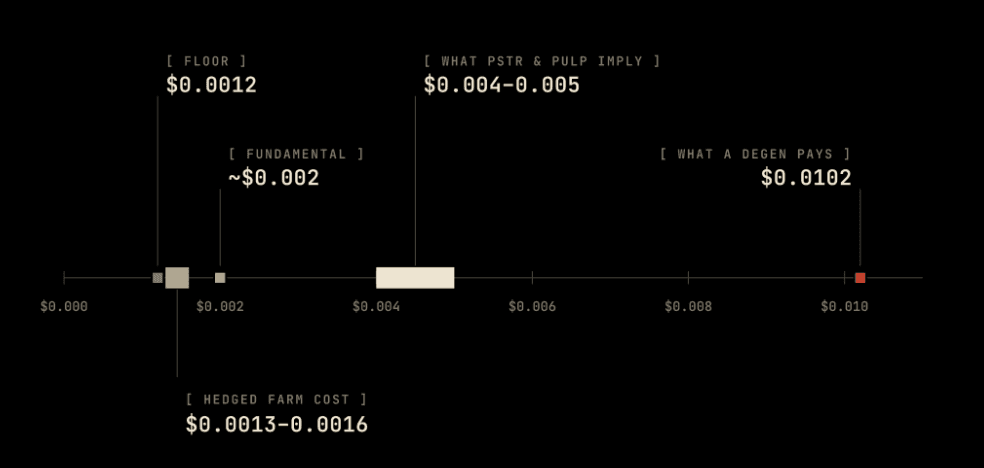
Start at the bottom. The cheapest PAPER can ever be made is about $0.0012. That is a hard floor on cost, not on price. If PAPER ever trades below it, farmers should stop farming, which would support the price, but nothing guarantees it. A careful hedged farmer pays a bit more, somewhere between $0.0013 and $0.0016. Our rough fundamental estimate sits around $0.002. That's the USDC each new PAPER brings stakers when most of the volume comes from real degens. Every $1 a degen loses adds roughly $0.18 to the LP and $0.018 in fees, and mints 98 PAPER.
The wrappers point higher. Two tokens already trade as bets on PAPER. PaperStrategy (PSTR) runs a treasury that farms PAPER on Papertrade, stakes it, and uses the yield to buy back its own token. PaperDAO (PULP) is a similar play with a $240k treasury aimed at PAPER. Strip away the branding and both are worth whatever PAPER their treasuries end up minting. That lets you back out a price. PSTR has an FDV of about $2.3M and roughly $0.8M of farming fuel. At a farm cost of $0.0014, $0.8M mints around 570M PAPER, and $2.3M spread across 570M PAPER comes to about $0.004 each. PULP trades at about $863k against its $240k treasury, which works out to around 170M PAPER and roughly $0.005 each. So the market is already paying about three times the farm cost for exposure to PAPER.
At the top is what a degen pays. Lose $1 on a directional trade and you get 98 PAPER after the fee, which is $0.0102 each. That's nearly eight times what a hedged farmer pays for the same token, and more than double what the wrappers imply it's worth.
Does farming pay off?
It comes down to one number: how much real degens lose once the LP has crossed $5M. We modeled a farmer who mints on day one at $0.0014 per PAPER and holds for a year.
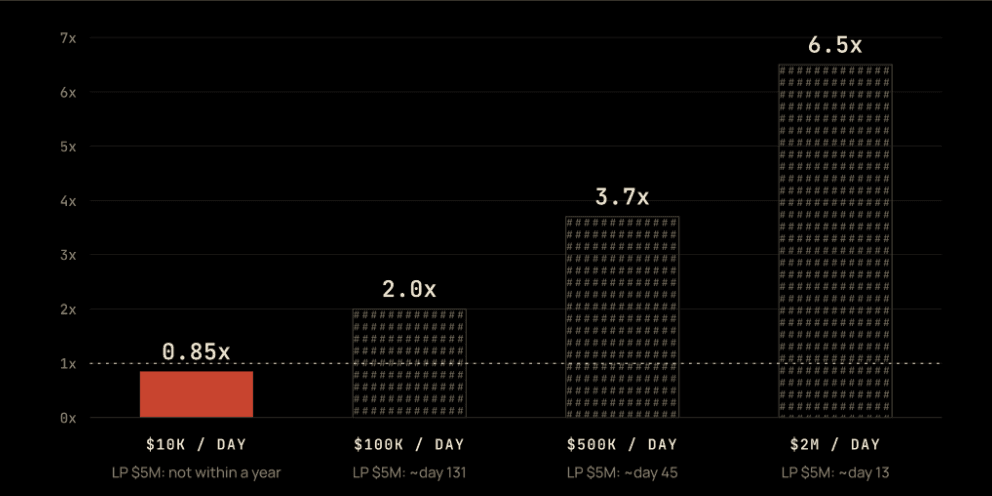
Below roughly $30k of degen losses a day, a year isn't enough to get your money back. Above $100k a day, early farmers do well, and the reason is the $5M line:
• Everything burned before the LP reaches $5M stays in the bankroll forever.
• Everything burned after it goes to stakers, including what every late farmer pays to mint.
PAPER minted before $5M collects a cut of everyone who pays to mint after it. That is the real early-mover edge. It has nothing to do with the first block and everything to do with being in before the LP fills up.
Who actually loses (and who wins)
"A lottery with no losers" sounds great until you list who's at the table. So yes, there are losers. They're the same people who lose at every casino — the ones betting big on direction at max leverage. Papertrade just hands them a receipt on the way out.
Frontend now, snipers later
Every trade on Papertrade is an on-chain transaction on HyperEVM, yet you never pay gas. That's because you never send the transaction yourself. When you connect, you register a session key that lasts 30 days. Every trade after that is just a signed message, and Papertrade's relayer turns it into a transaction, pays the gas and lands it on-chain. If your order doesn't get in within an hour, it expires. Deposits skip gas too. Each account gets its own deposit address, with a one-time 1 USDC activation fee.
That fixes gas but creates a line. HyperEVM block space is limited, so the relayer decides who goes first. Liquidations jump the queue, and big orders go before small ones. For now that's the only way in, since trading at launch runs through the frontend and direct contract access comes later, with no date announced.
Once the contracts open up fully, expect snipers. The price you get is Hyperliquid's mid in the block your trade lands in, not the one you saw when you clicked. A bot that watches Binance can land a trade before Hyperliquid's book catches up and lock in a price that is already stale. The haircut makes this pointless on tiny moves, but on a fast 1% candle it only takes about 14% of the win, and the rest comes straight out of the LP, which means out of stakers' pockets. Expect the same race for open-interest room. Each time the cap moves up, the first trades to land get the space. If you farm by hand, plan on being the slowest player at the table once bots can go direct.
Risks nobody tweets about
1. The price can be pushed. Papertrade reads Hyperliquid's mid price live and never checks it against an outside price. Someone who briefly moves Hyperliquid's book can trade Papertrade at the distorted price and take the difference from the LP. This is a potential attack vector, not a demonstrated exploit. To profit, an attacker has to push Hyperliquid's mid far enough that the move survives the haircut, hold it there for the block Papertrade reads, and make more on Papertrade than it costs to move a real order book. On BTC and ETH, the deepest books on Hyperliquid, that is expensive. The haircut, the dead zone and the open-interest caps make it harder still. The docs list it as an open risk.
2. The relayer is a single point of failure. Every trade and every staking action goes through Papertrade's own server. If it stalls, you can't close a position, but liquidations still fire. Withdrawals are safe: they work straight from the contract.
3. IOUs can turn into bad debt. The queue only clears if new losers keep arriving.
Verdict
Papertrade isn't a lottery with no loser. It's more like an honest casino with one strange twist — the losers end up owning the house. But "no losers" only holds for people who understand the mechanics. Directional degens at 1000x still lose most of every dollar they put in. The people who come out ahead get their PAPER cheaply through hedged pairs, before the LP fills to $5M, and then collect from every degen who shows up after them. If you're going to play, play like the house.
Not financial advice. Papertrade, PAPER, PSTR and PULP are experimental, and you can lose everything you put in. Modeled figures are estimates built on the launch parameters published in the docs as of October 9, 2026, and the protocol owner can change those parameters.
Building something interesting? We back founders shipping the next generation of crypto infrastructure.
Work with us →Five Minutes to Settlement
Five-minute contracts generated $7.8 billion in trading on Polymarket and Kalshi in the first half of 2026. For the repeat trader, fees, cancellation times and settlement speed determine whether entering each new window makes sense.
Can AI See What the Market Misses?
In a study of 322 liquid-market events, AI combined with market prices outperformed either alone. A forecaster doesn't need to beat the market to be useful.