Intro
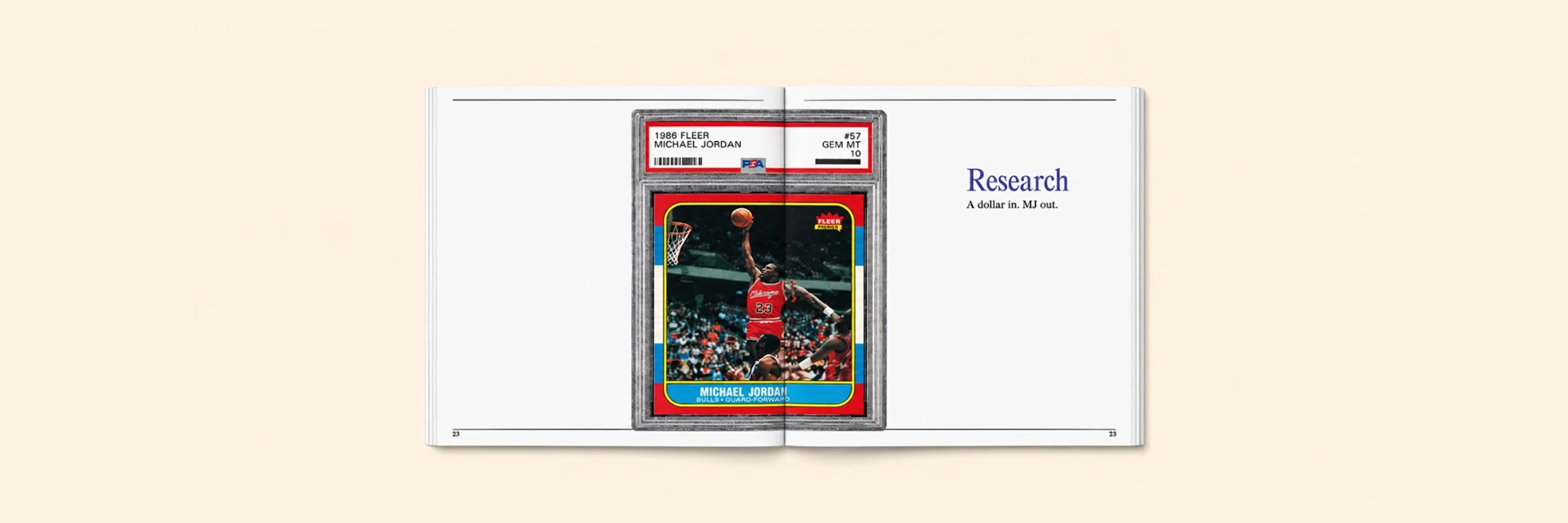
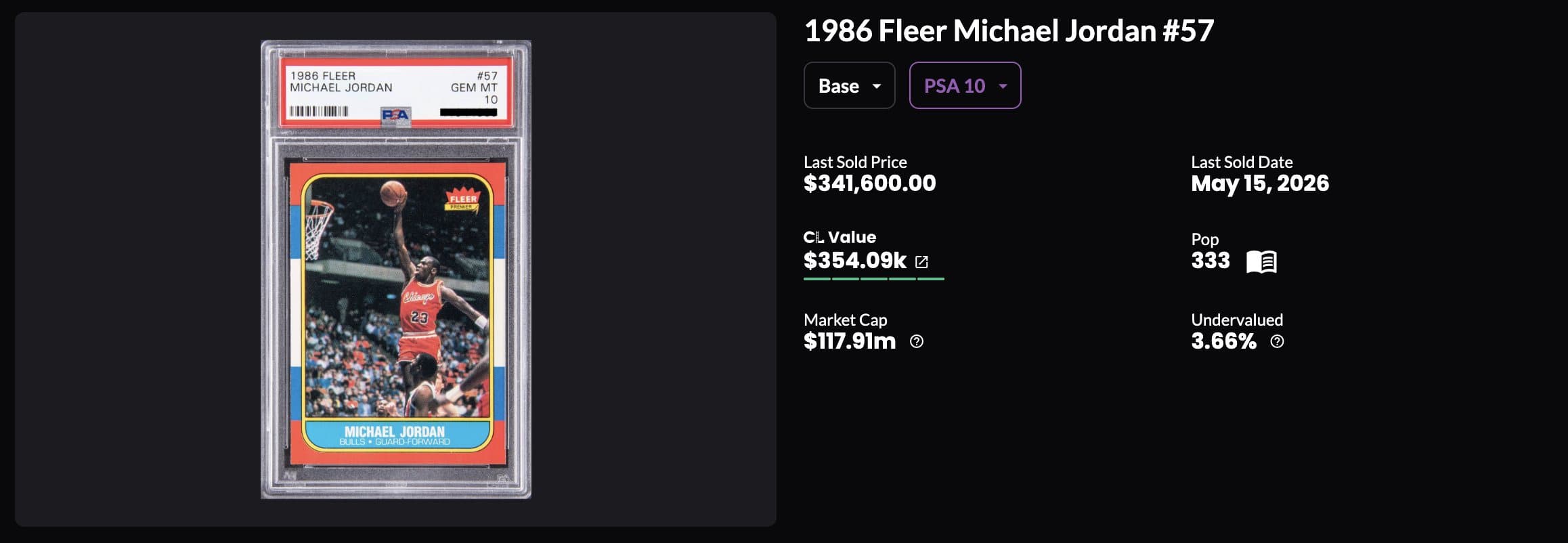
Two weeks ago, someone paid $341,600 for a cardboard rectangle. 3.5 inches by 2.5 inches. Printed in 1986. It has Michael Jordan on it mid-air, Bulls jersey, number 23 — and a PSA 10 label on the case that means it came out of a pack forty years ago and somehow survived in perfect condition.
Today, you can own a piece of that card for a dollar. Not a picture of it. Not a derivative. Not a bet on someone else's ownership. An actual, provable, on-chain fractional claim on the physical object sitting in a vault right now.
And here is the part that should make you stop scrolling: that on-chain claim is currently priced at a 5–7% discount to what the card sells for in the real world. The gap is sitting open on a public DEX and anyone can step in.
This is about why that gap exists, what keeps it in check, and what it means that one of the most iconic trading cards ever printed now trades like a token 24 hours a day, on Uniswap, starting at any amount.
From cardboard to chain
In 1986, Fleer printed the first nationally distributed basketball card set in five years. Jordan's #57 was one of 132 cards in that set — not technically his first card, but the first mass-market, officially licensed one that collectors could actually find. Nobody at the time knew what they were holding.
Forty years later, a PSA 10 copy of that card — Gem Mint, the highest grade, meaning the cardboard survived four decades without a crease, a scratch, or a speck of dust — sold for $341,600. There are roughly 333 of them known to exist and that number barely changes. The grading standards for a card this old are severe: pulling a new PSA 10 from raw stock gets harder every year as the remaining copies age.
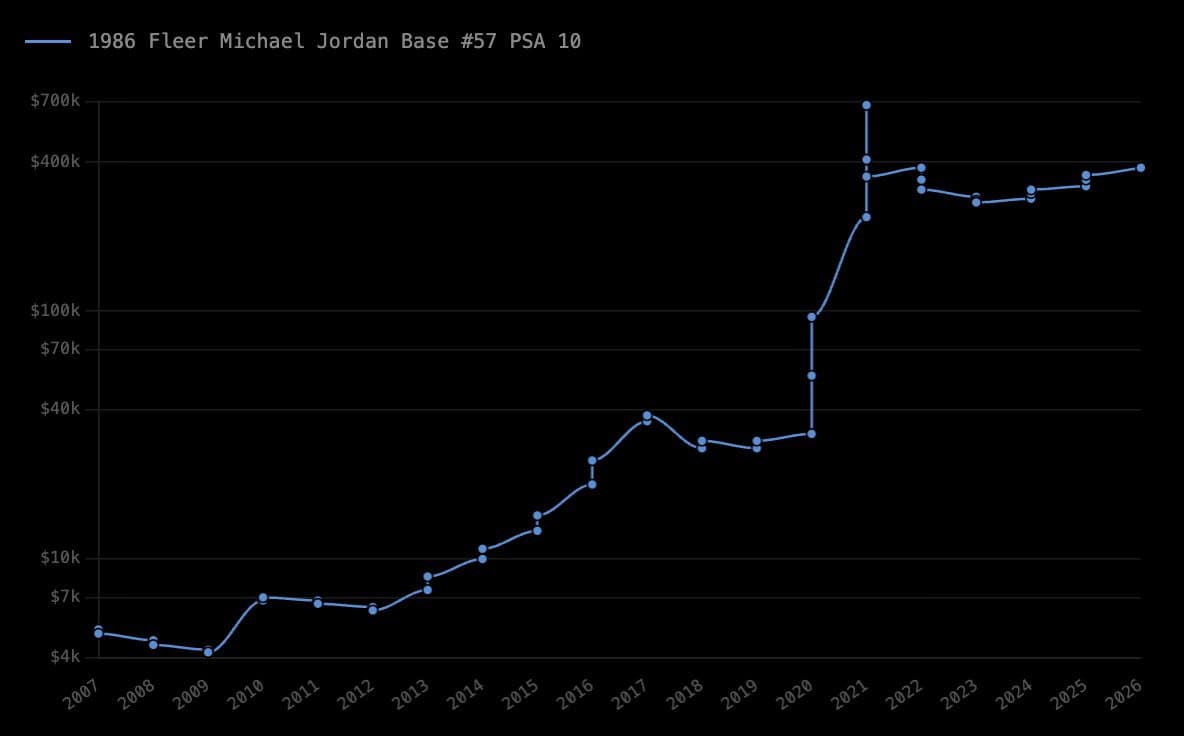
The price chart tells the story of the hobby itself. Single-digit thousands through the 2000s, then a slow grind upward as Jordan's legacy calcified into canon. A parabolic spike to $700,000 in 2021 when pandemic money flooded into collectibles. Then a correction. Then a floor from $200K to $350K that has held for two years and counting. The card trades like a blue-chip asset because that is what it became.
For the entire history of this card, owning it meant finding somewhere north of $300,000 and outbidding everyone else. There was no middle ground — no way to own 1% of it, no way to get in for a thousand dollars, no way to exit without finding another collector willing to write the same size check. It was a closed market by default, not by design.
What gMJ by Grail does is break that. Two physical cards sit in a vault. Against those cards, 20,000 tokens were issued — each one representing a 1/10,000th share of one PSA 10. They trade on Uniswap like any other token. You can buy a single one for about $32, hold it alongside your other crypto, use it as collateral, or sell it tomorrow. And if you ever accumulate 10,000 of them, you can redeem the whole stack for the physical card, which gets shipped to you.
The token supply is tied directly to what is in the vault. No new gMJ gets minted unless another card goes in. If someone redeems their tokens for the physical card, those tokens are burned. It is a simple system, and that simplicity is load-bearing.
Two prices
This is the central mechanic that makes gMJ interesting from a market perspective. There is not one price for this card — there are two. And understanding the gap between them is the entire thesis.
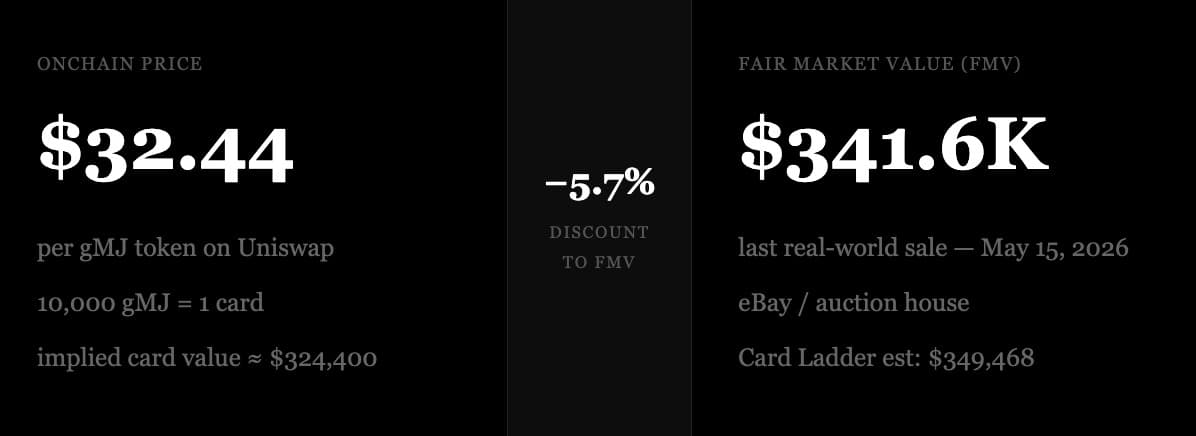
The on-chain price is what the market will pay for gMJ tokens on a DEX right now. The FMV is what the physical card last sold for in the real world — on eBay, at Heritage Auctions, at Goldin.
These two numbers should, in theory, converge. The arbitrage mechanism that forces convergence is redemption: if the on-chain price falls too far below the card's real value, someone can buy enough tokens to redeem the physical card, then sell it at market price and pocket the difference. That structural pressure keeps the discount bound.
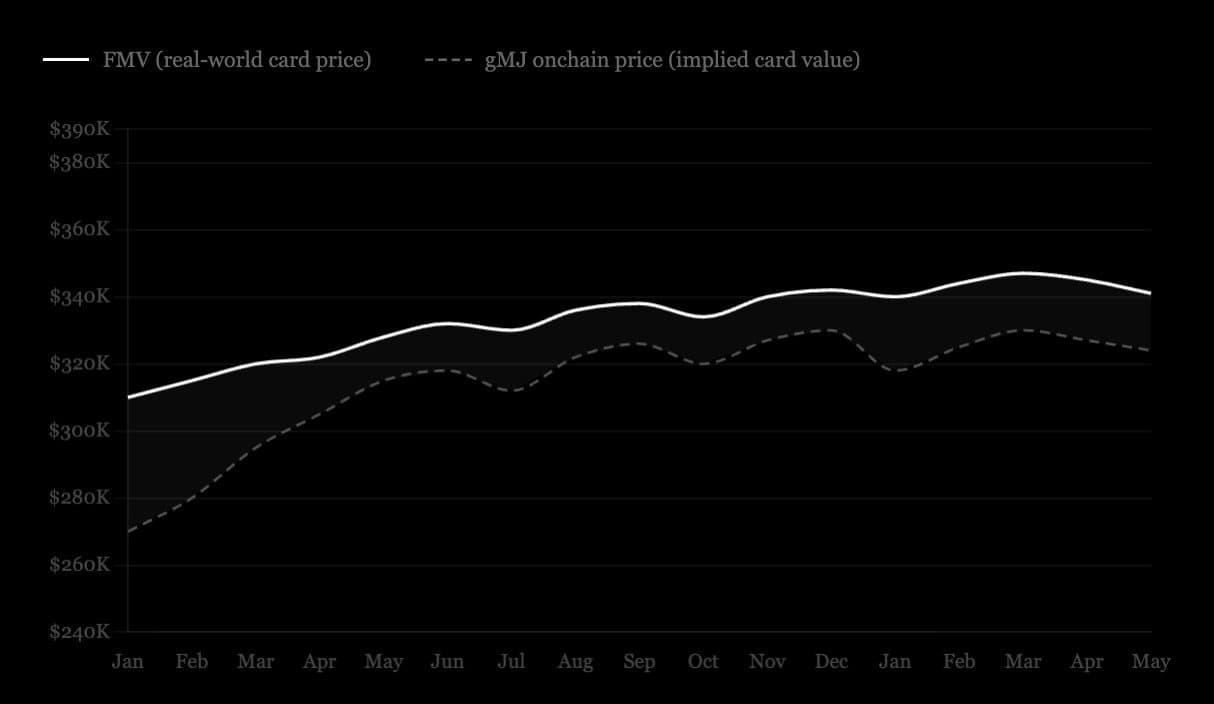
Right now that discount is sitting at approximately 5–6%. Not because the market doesn't know — it does. The discount reflects liquidity, complexity, redemption friction, and the fact that the card itself trades rarely.
This is not a guaranteed trade. Slippage, gas, redemption fees, and card sale execution eat into the spread. But the structural logic is sound: the two prices are connected by a real, mechanical redemption path. That connection is what makes gMJ fundamentally different from a meme coin or a pure speculative token.
Anyone, any amount
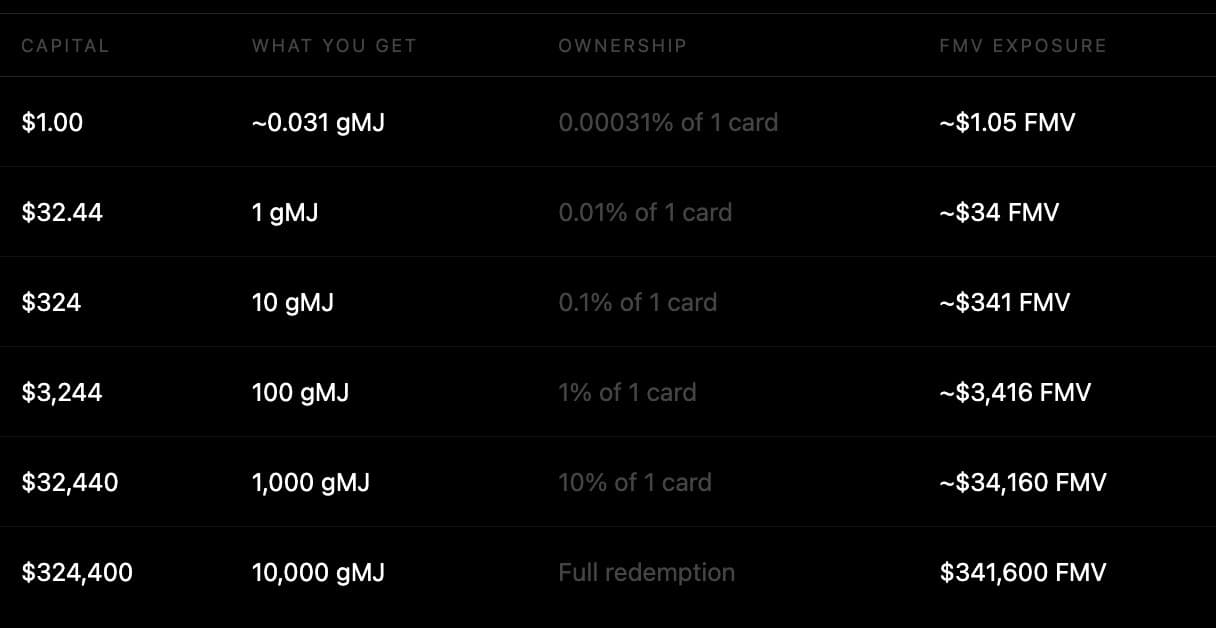
The entry point is not $300,000. It is not even $100. gMJ trades like any ERC-20 and you can buy a fraction of a token, so $1, $10, or $50 all work the same way. Before Grail, fractional ownership of this card was either private — closed platforms, accredited investors only — or physically impossible.
Think about what that actually means. If you have $15 sitting in a wallet right now, you can own a provable slice of the most valuable trading card in the world — not a representation of it, not a receipt pointing at someone else's custody, but a direct on-chain claim on the physical object in the vault. The same card that last sold for $341,600. You get in at a discount to that price, you hold alongside every other token in your portfolio, and you sell whenever you want.
The signal
Tokenized collectibles processed over $124 million in trading volume in a single month in 2025. The category is still early: volume thin, participation mostly retail, institutional money barely present. gMJ sits at the better end of that landscape — a real arbitrage floor, a real redemption path, and an underlying asset with forty years of price history. Most tokens in this space have none of those things.
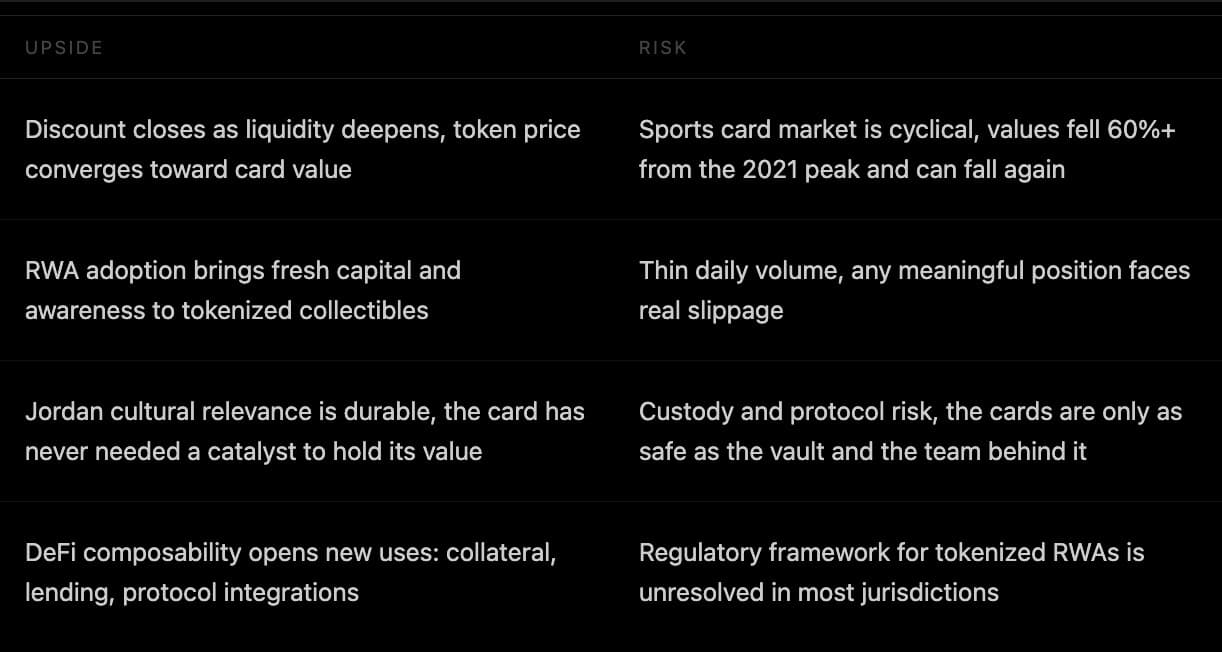
The 5–7% discount to FMV exists because the market is small and liquidity is shallow. That is not a permanent condition. As more capital finds this trade and the arbitrage gets exercised, the gap compresses.
Anyone who wants exposure to this card today can spend $341,600 at auction, or buy gMJ for whatever amount they choose and sit at a discount to that same price. One of those options did not exist two months ago.
If any of this made you curious, the right move is simple — go to grail.xyz, look at the gMJ page, and see what the spread is right now. Everything discussed in this piece is verifiable in about thirty seconds.
Building something interesting? We back founders shipping the next generation of crypto infrastructure.
Work with us →gSPEED: the first memecoin with a floor under it
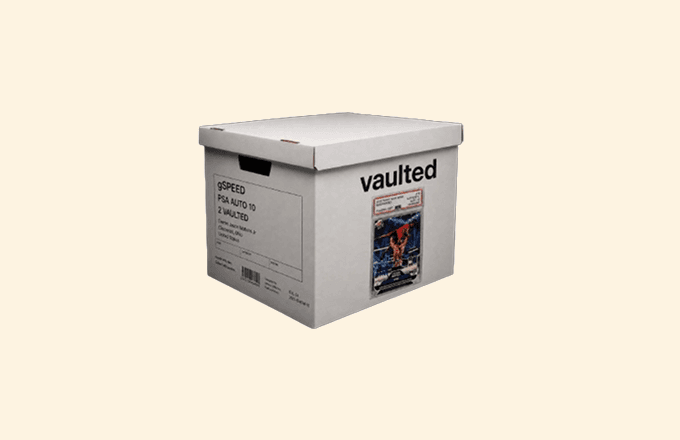
Every SPEED token before this one is now worth a rounding error. gSPEED is different — each token is a fractional claim on a real, vaulted iShowSpeed PSA 10. A meme with a redemption floor.
When Attention Became Capital
For twenty years the internet sold your attention to advertisers. Now it is teaching you to trade it yourself.