Intro
The Clock Is Ticking
Five-minute contracts have grown into a market for repeat trading. Pantera Research Lab estimates that contracts measured in minutes or hours generated $7.8 billion of trading on Polymarket and Kalshi in the first half of 2026, roughly 77% of their combined crypto volume. At 50 cents, an UP share can return twice its purchase price before fees, even when Bitcoin finishes only slightly above the opening reference. That embedded leverage and a result within minutes help explain the attraction for repeat trading. The position can also expire worthless; a fully paid buyer risks the purchase price and fees.
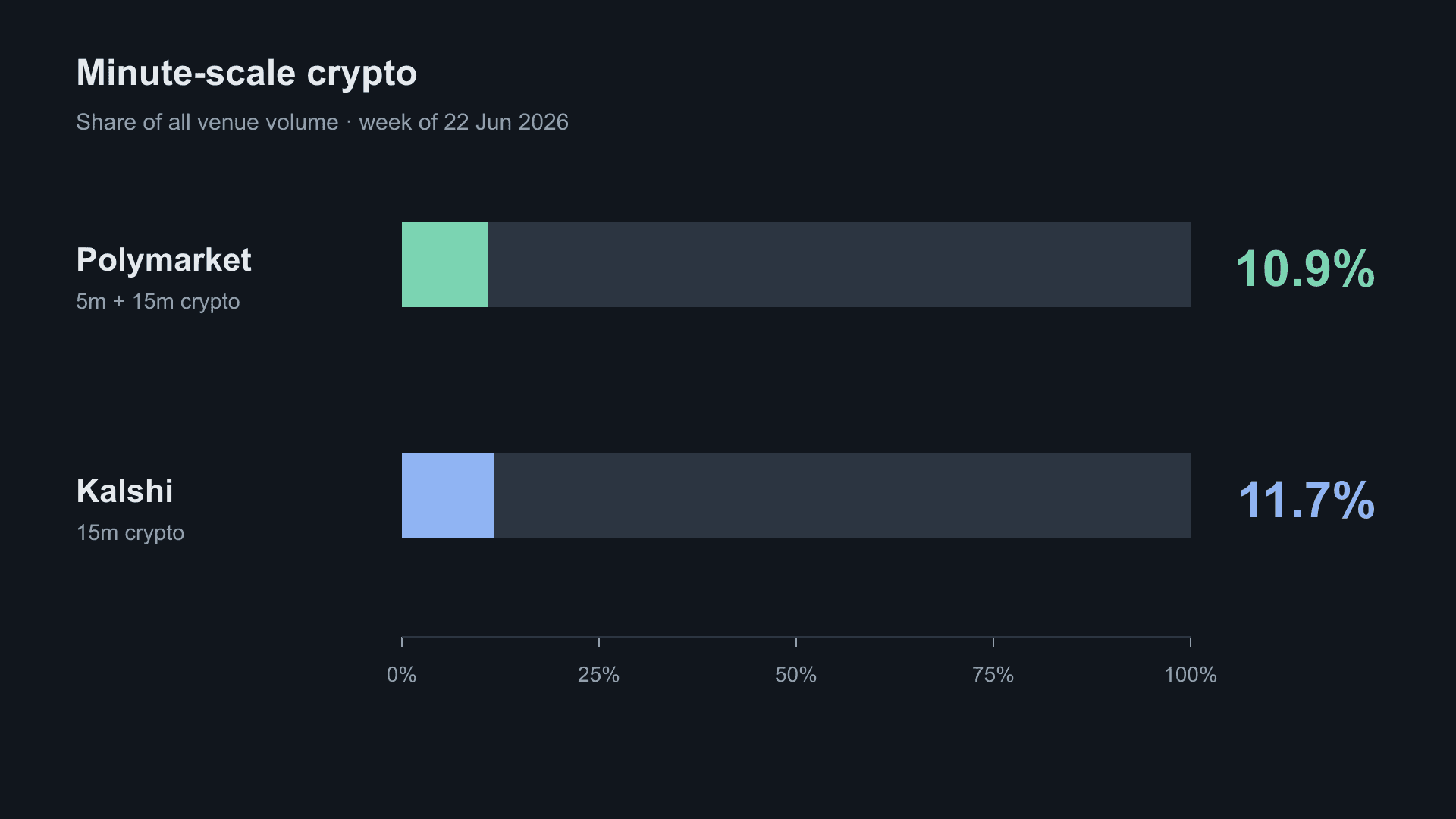
Minute-scale crypto contracts also take a measurable share of total venue activity. In the week beginning June 22, five- and 15-minute crypto contracts accounted for 10.9% of Polymarket's total trading volume; Kalshi's 15-minute crypto contracts accounted for 11.7%. The same weekly datasets show Kalshi's 15-minute crypto volume rising from $3.7 million in early January to $370 million in late June.
For someone returning every five minutes, those contracts need to be economical to trade repeatedly. Fees can absorb a small forecast edge, and cancellation delays that stretch during a price move leave makers exposed when their quotes are most vulnerable. Proceeds released too late cannot fund the next entry. These constraints give specialised venues an opening: a book built around repeat trading has to remain usable through the closing rush.
The Cost of Moving the Close
The first constraint is the price that decides the payout. A trader can call Bitcoin's next move correctly and still misprice a contract that settles on an average. Polymarket's five-minute crypto markets use a 60-second Chainlink TWAP for both the opening reference and the final settlement price, following the August rule changes. As the closing minute passes, part of the outcome becomes fixed in the average. If its first 40 seconds average $60,020, the final 20 seconds need to average at least $59,960 for UP to win in this example, against an opening reference of $60,000. Two-thirds of the time weighting is already known. Pricing the contract requires carrying that history forward and estimating the next price move.
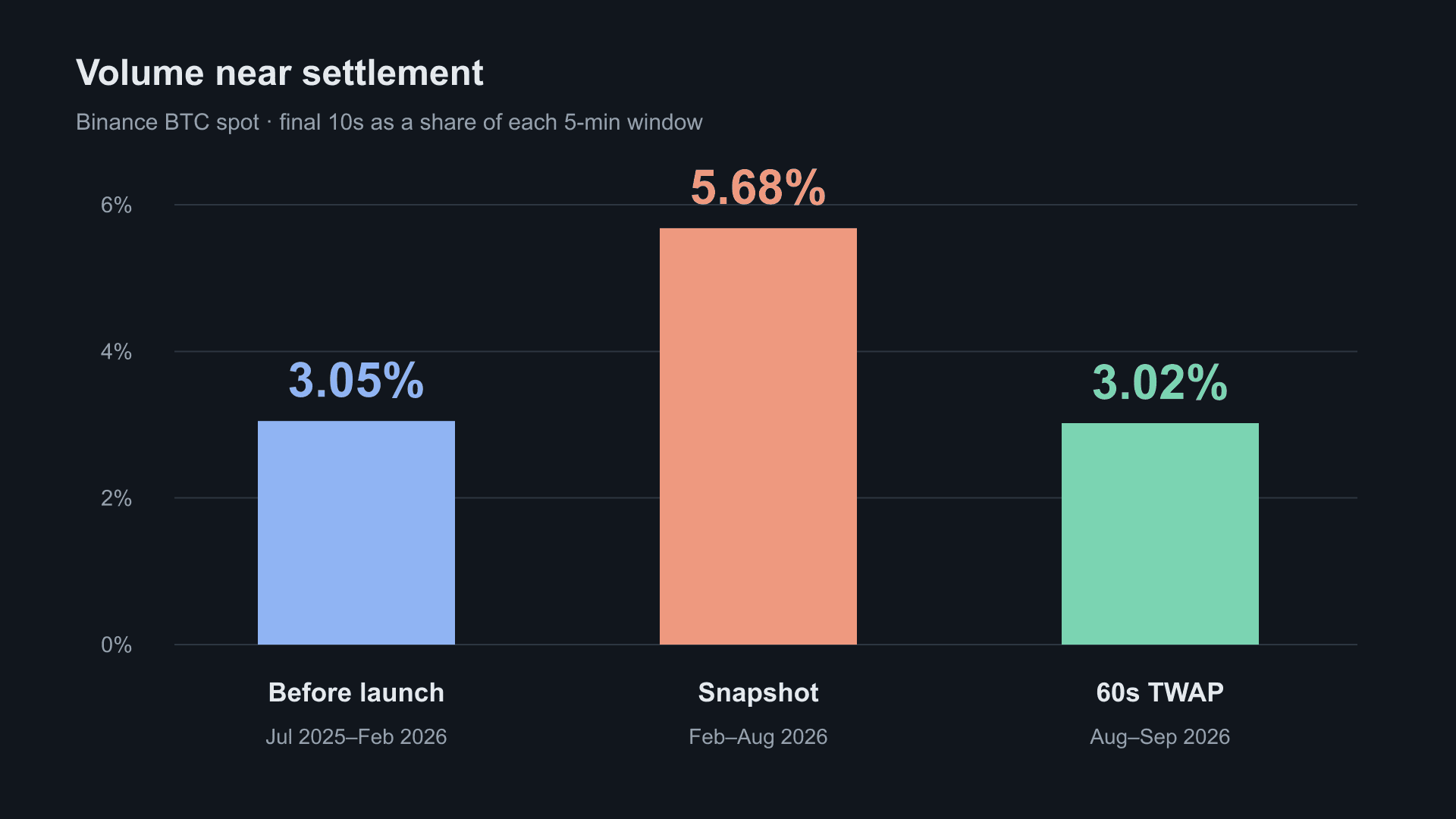
Averaging also changes the incentive to trade the underlying into settlement. A recent study measured Binance BTC spot volume at five-minute boundaries, excluding simultaneous longer expiries. The final ten seconds carried 5.68% of each window's volume under snapshot settlement, against 3.05% before the contract launched. In the first three weeks of 60-second TWAP settlement, that share was 3.02%, and the near-strike price reversals ceased in the sample.
Teodor Tankov's post-TWAP analysis likewise reports a sharp reduction in late pushes, while treating residual activity cautiously. His cost estimates make a separate point: the dollars traded to move spot are much larger than the economic cost of fees, slippage and carrying the position. Those estimates are modelled scenarios, rather than observed attack bills. As binary exposure grows, a trader can gain more from changing the outcome than it costs to move the reference. Averaging raises the cost of a push, but the economic test still depends on how much binary exposure is at stake and how liquid the underlying is. Position limits and the averaging window still need to suit each underlying, with published rules for ties or missing observations so traders can reconstruct the payout.
Right Call, Wrong Trade
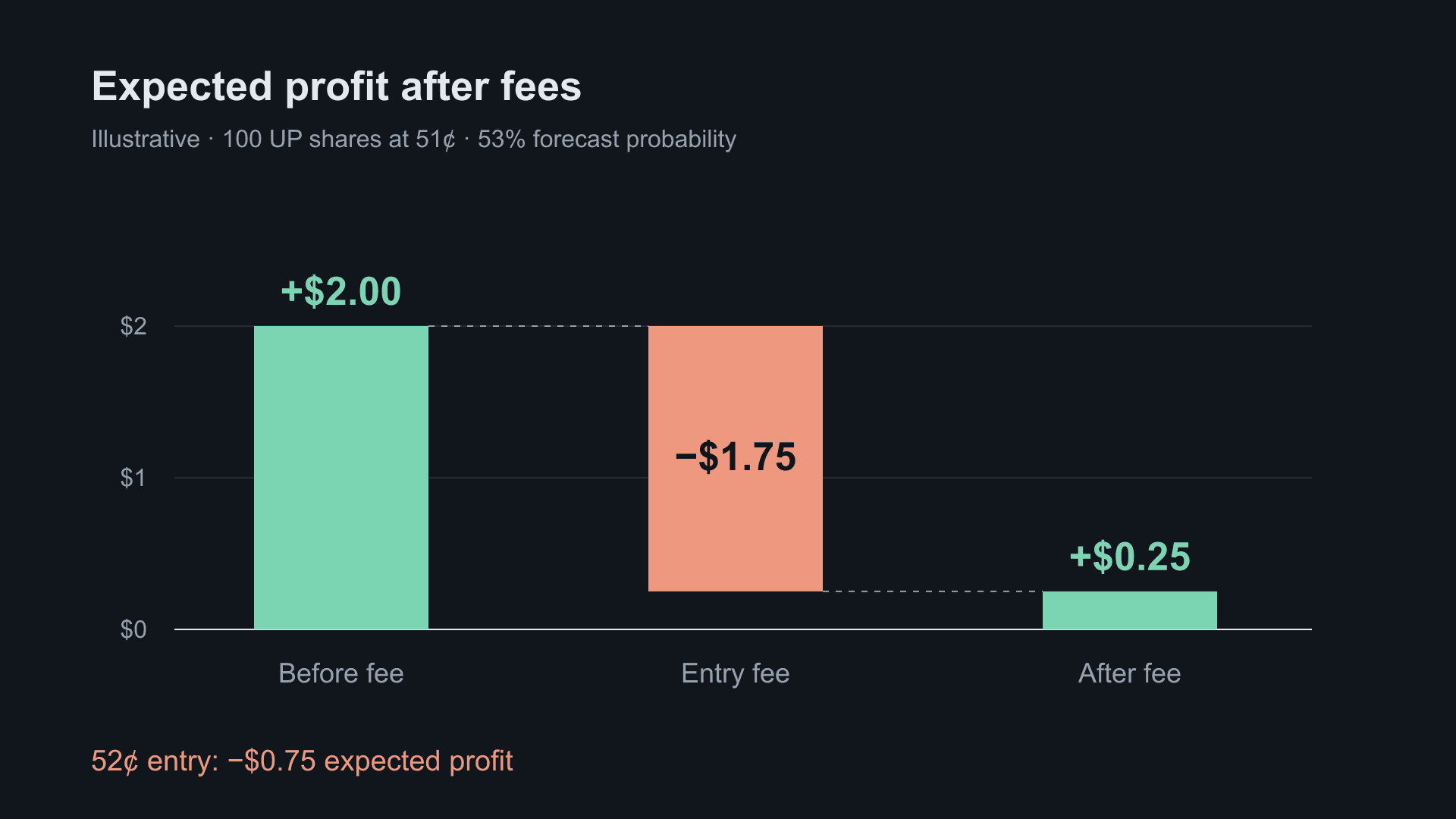
A trader estimates a 53% chance of UP winning and finds an offer at 51 cents. On 100 shares, the two-cent difference gives $2 of expected gross profit. The crypto entry fee takes about $1.75, leaving 25 cents before slippage or any other cost. The calculation assumes the forecast is right on average and the shares are held to redemption. Paying 52 cents instead turns the expected result into a loss of about 75 cents, with the same forecast. Whether the trade works depends on the price available for the full order, after fees. An early exit introduces another execution price and may incur another fee.
The fee also takes a larger share of the purchase price on cheap contracts: under the crypto formula, it is 6.3% of money spent at 10 cents, versus 0.7% at 90 cents. Long-shot buyers face the higher percentage cost.
A maker leaves a bid for 1,000 UP shares at 50 cents. In this illustrative burst, a move in Bitcoin cuts its valuation to 42 cents and the cancellation takes longer than usual. The old bid fills: $500 paid for a position now marked at $420. A maker can allow for a predictable delay; a delay that expands as the price moves makes that allowance unreliable. Quoting less size or a wider spread raises the cost for takers. Quoting both sides creates another source of exposure. If only the bid fills, the maker is left holding UP rather than earning the spread on a completed round trip. Research on crypto UP/DOWN market making evaluates joint-fill outcomes and the inventory left behind. The displayed spread alone can overstate the return available to the strategy.
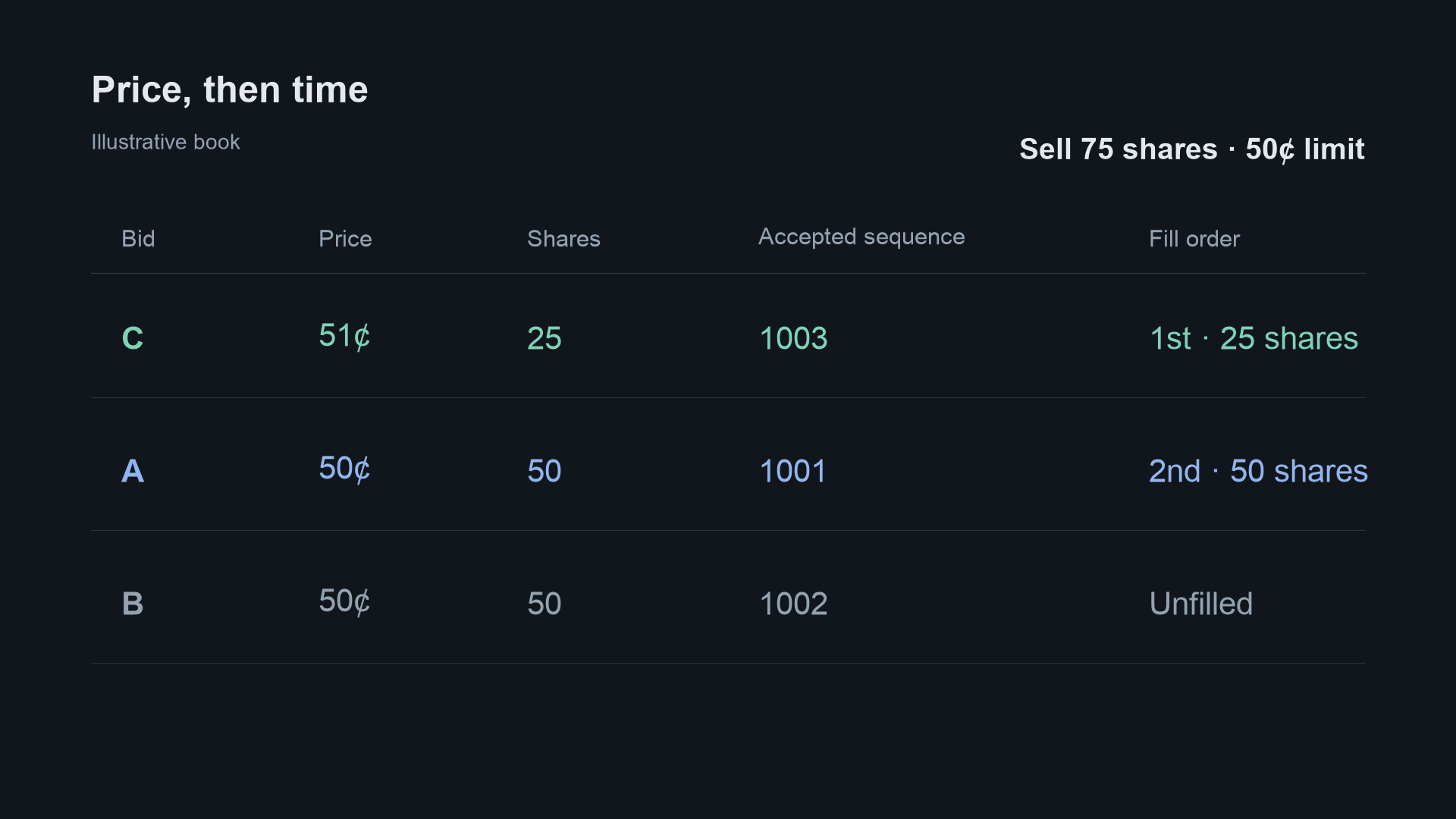
For the maker trying to cancel that 50-cent bid, a fast acknowledgment is an incomplete benchmark. A valid cancellation admitted ahead of the taking order should remove the quote before it fills. Checking that requires a numbered record of placements and cancels at a defined admission boundary. A deterministic sequencer makes the processing order reproducible; the record must also let participants check that price-time priority was applied to that sequence.
Polymarket order lifecycle also includes deliberate delays for applicable orders. These are venue rules that affect when an order can trade, alongside network and processing time. Any latency comparison needs the market configuration, test date and request type: the rules have changed, and a marketable limit order is a different measurement from a resting order cancellation.
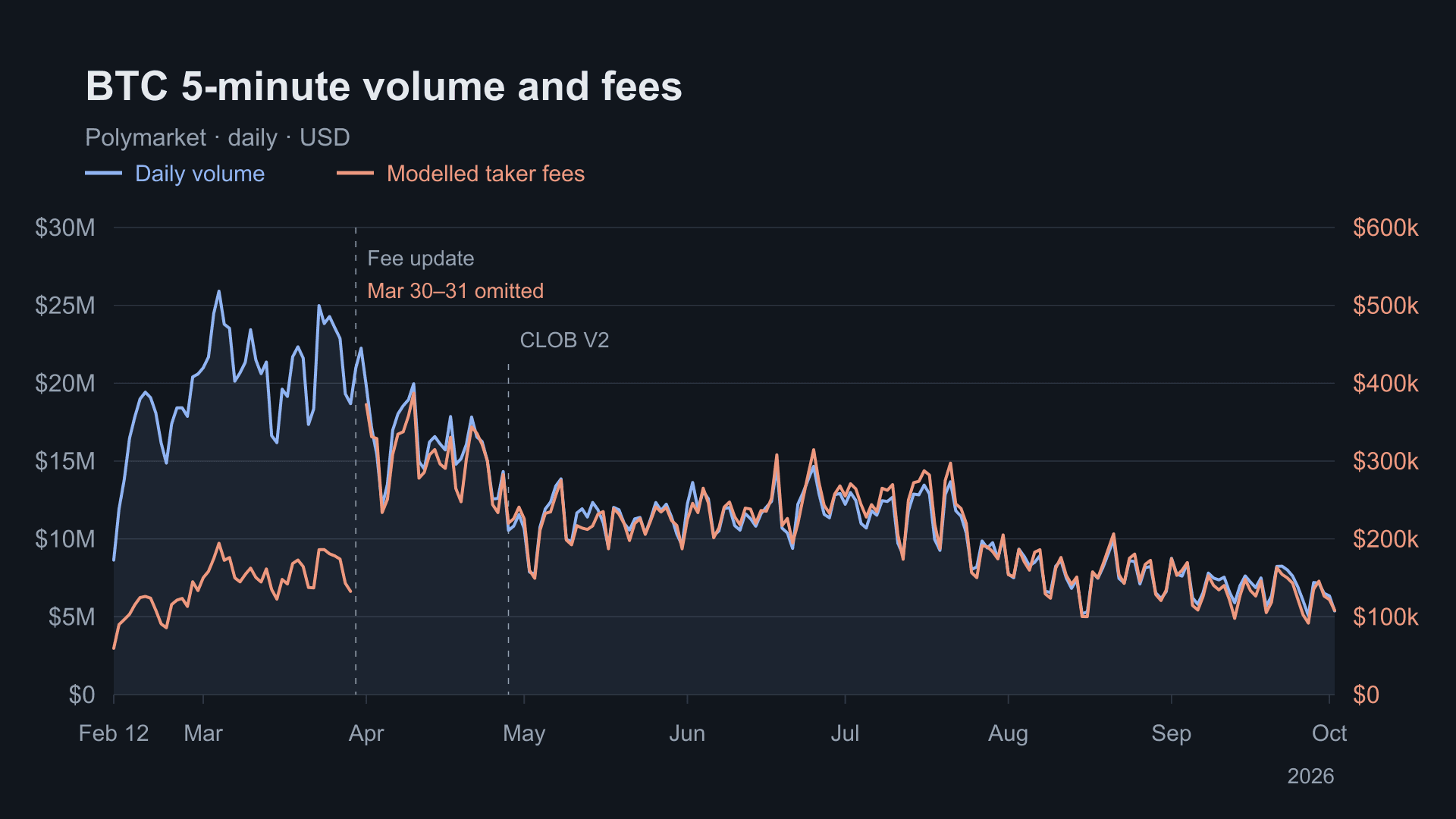
Polymarket BTC five-minute markets averaged $7.1 million a day in September, against $21.4 million in March. Between the weeks beginning 23 March and 21 September, active maker wallets fell from 22,920 to 5,776, while active taker wallets fell from 57,300 to 19,092. Yet average weekly turnover per active maker wallet rose from roughly $7,000 to $8,500. The remaining activity was spread across fewer wallets.
In the September comparison week, median maker turnover was just $97, against a mean of $8,473. The mean wallet is a poor guide to how much a typical account trades. These weekly counts do not track the same traders over time or establish why activity fell. They give a new venue a more demanding target than launch volume: sustaining participation while keeping quoting economical. Whether the remaining turnover supports executable depth near expiry still requires order-book data.
Getting Your Money Back
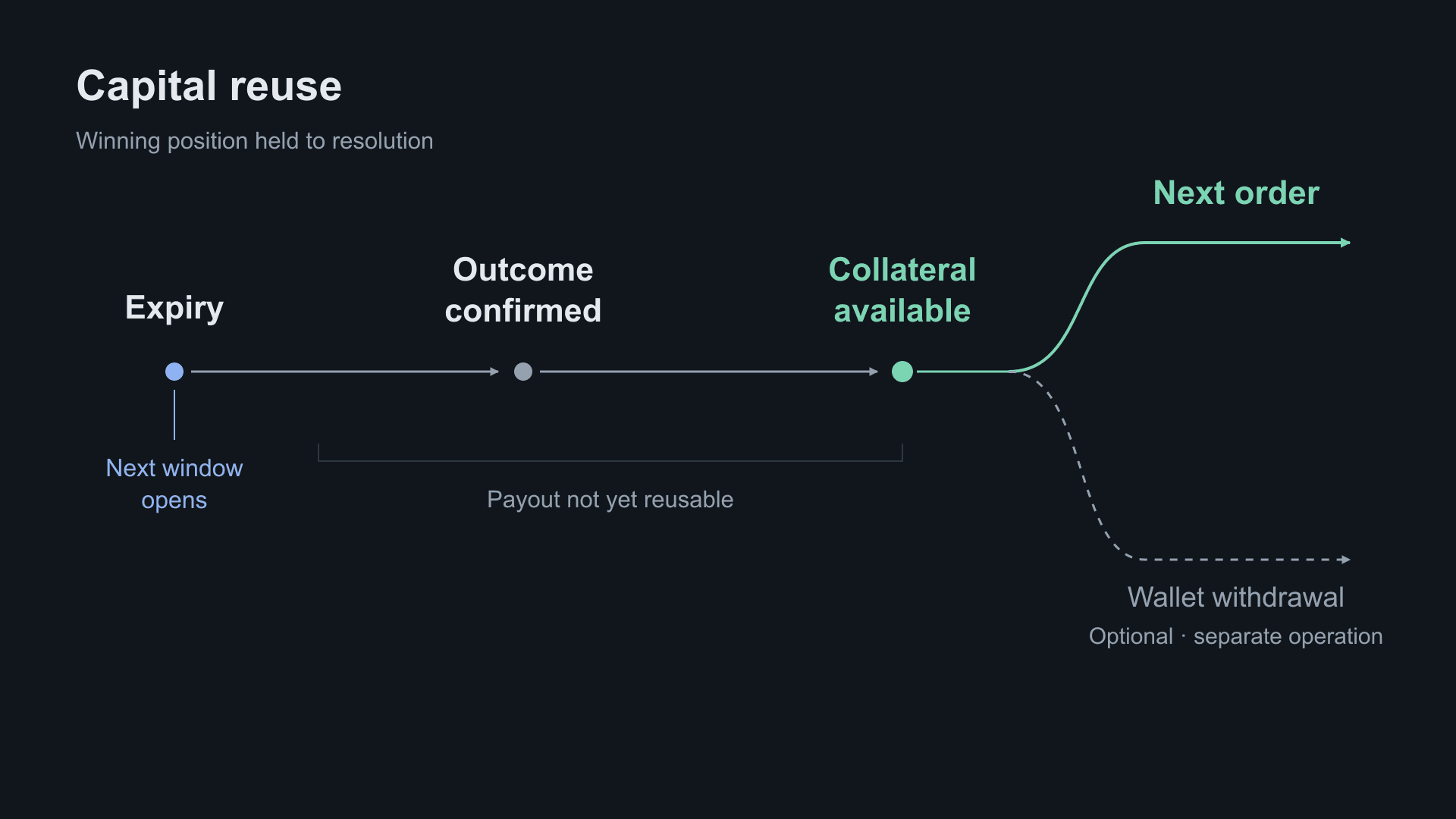
A five-minute expiry can arrive before the proceeds are available for another trade. A winning position still needs its outcome confirmed and its payout credited. For a strategy entering successive windows, the immediate concern is whether enough collateral is available for the next order. Keeping funds on the venue avoids a withdrawal after every round, but it does not remove the wait for settlement.
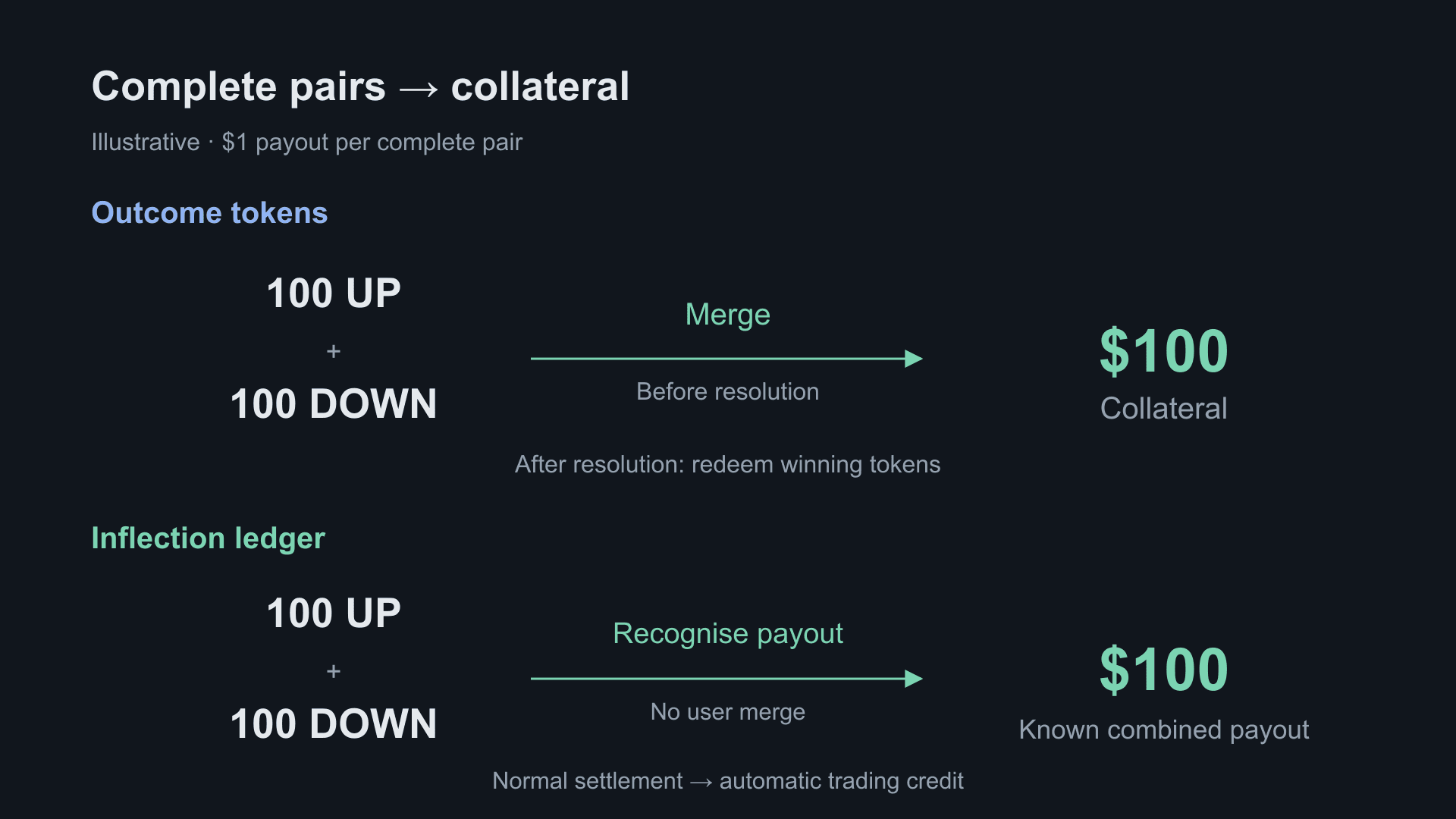
Before resolution, a trader holding UP can sell it into the book or buy DOWN in the same market and merge the complete pair back into its $1 of collateral. The merge route depends on the price and availability of DOWN, which must be paid for before the collateral is released. An opposite position in another expiry cannot be merged with the original shares. Polymarket documents these operations in its guide to split, merge and redemption.
For a maker quoting successive windows, neither exit is guaranteed at an attractive price. Selling UP may mean crossing a wide spread; buying DOWN can bring the pair's total cost above $1, locking in a loss before fees. Even when both quotes appear to offer a profitable pair, one can disappear before the other leg fills. The next window may already be open while the maker is still trying to turn its remaining inventory back into usable collateral.
Inside Inflection
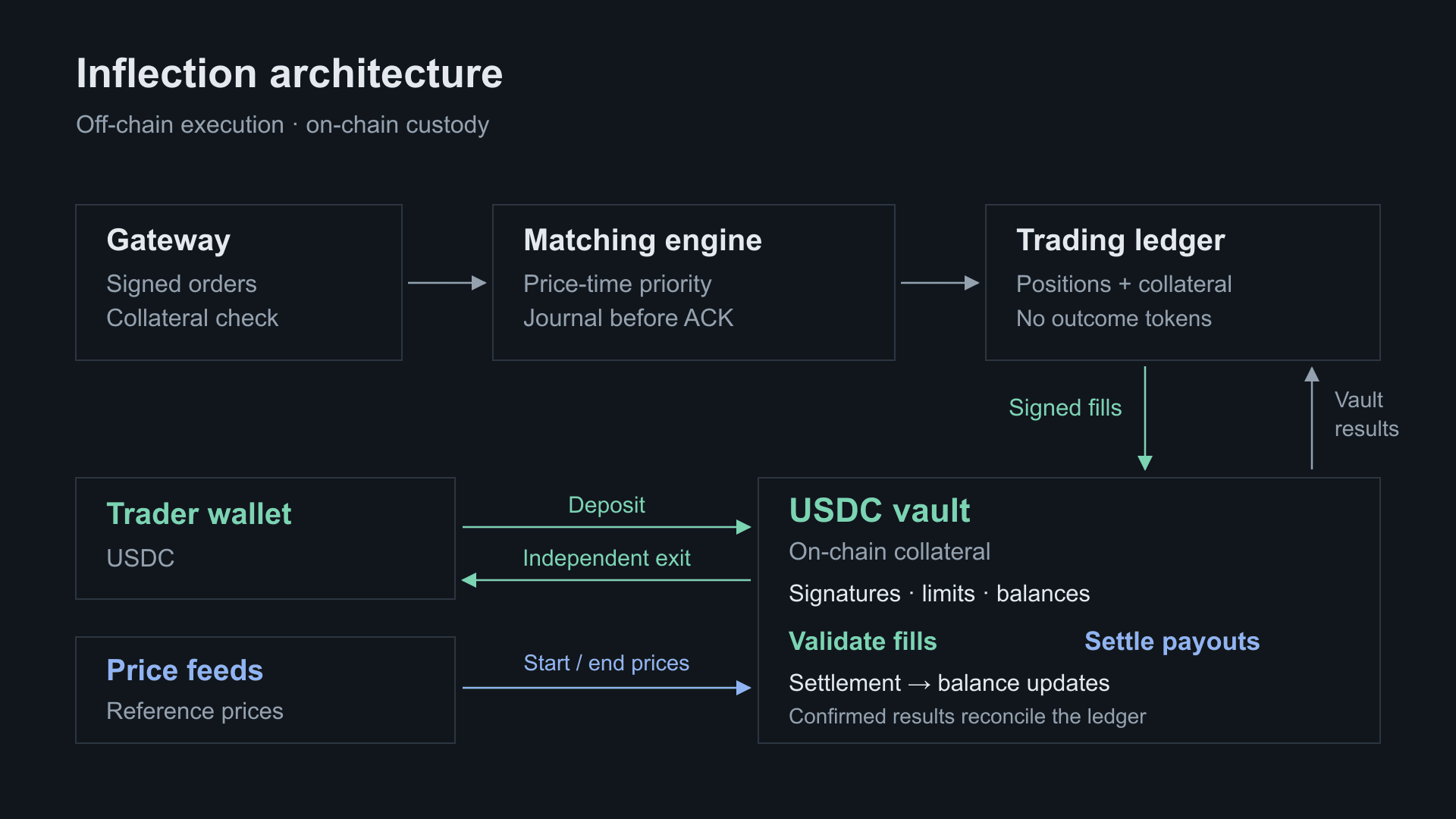
Inflection is building a venue for traders moving from one short window to the next. Inflection offers trading in one- and five-minute BTC, WTI and NVDA markets, with its USDC vault on Base. Its planned fee model targets lower fees and less variation in fees per dollar spent.
The ledger recalculates available collateral after every fill. A matching UP/DOWN pair in the same market has a fixed combined payout, which it recognises without minting or merging outcome tokens. At settlement, proceeds return to available collateral without a separate redemption. Recognising a complete pair saves the merge operation, but the maker still has to acquire both legs at executable prices. Reserved cash also has to become position exposure consistently, so a filled bid cannot briefly appear to leave money free for another quote.
A failed match creates a different problem for a trader who has already hedged it. The Ghosts of Polymarket documents fills reported off-chain that later failed on-chain, leaving the counterparty to manage any position taken in response. The study covers August 2025–August 2026 and reports partial mitigation. Inflection posts signed fills to the vault in small batches, usually within seconds. The vault checks the orders and their authorised keys, signed limits, fees and cash balances. A fill that fails validation is skipped while other valid fills still apply; the exchange reverses the skipped fill in both accounts. An off-chain fill notice and a fill applied by the vault are therefore different stages of the trade. Trading collateral and withdrawable cash are separate while fills and settlement are pending. The vault pays the requested amount or the cash then available, whichever is lower. Unpaid positions must first resolve and pay into cash; the exchange can handle that normally, while the independent exit provides a route when it is unavailable.
Orders, cancels and market-lifecycle commands enter a single-threaded Rust engine. Every input receives a sequence number and is journaled before acknowledgment. The engine serves the best price first and the oldest order at that price. Replaying the journal can verify fills against the recorded sequence and reconstruct the book after a restart. An admission dispute also needs gateway receipt and sequencing records, since replay starts from the order already recorded. Inflection applies the same engine rules and limits across accounts and rules out payment for order flow; network travel still affects arrival time.
The tests cover repeatability as well as speed. Re-executing two million random inputs reproduced the journal byte for byte, and a restart restored all 1,041 resting orders. Across five scenarios of about two million messages each, including a flash crash, matching agreed with a common reference; each run also passed 192 state comparisons with liquibook. These checks support the engine's ordering and recovery behaviour. They do not measure the time for a vault settlement or a wallet withdrawal.
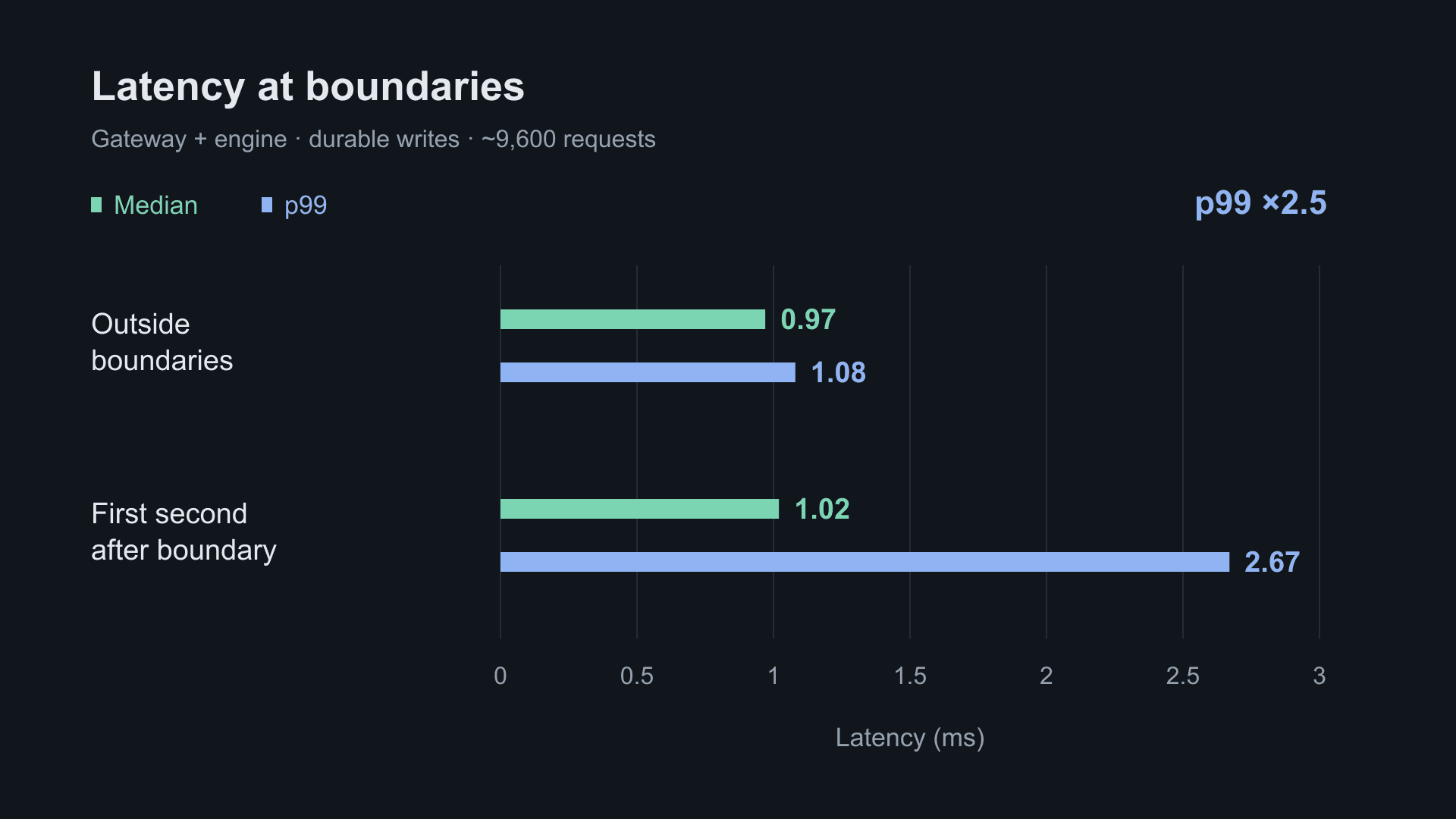
In gateway-and-engine burst tests of about 9,600 requests, with durable writes and no network travel, median latency was 0.98 ms and p99 was 1.87 ms. At market boundaries, the median moved from 0.97 to 1.02 ms while p99 rose from 1.08 to 2.67 ms. The boundary tail is relevant when a client is retiring old quotes and preparing the next market.
BTC schedule charges $0.875 to take 100 shares at 50 cents, with 20% of that fee returned to the maker. That is half the $1.75 charge under Polymarket's current crypto formula at the same price and size. Inflection's fee still varies with the share price, and rates are fixed when each market is listed. Testnet outcomes currently use an operator price reporter; the documentation names Pyth feeds for the oracle route.
A Market Worth Coming Back To
A retail trader following NVDA earnings, oil inventory reports or a familiar index could express that view through a short contract with a fixed stake, expiry and payout. The appeal is a trading window tied to something they already follow. Cboe reports 3.4 million daily SPX 0DTE contracts in September 2026, evidence of demand for short expirations, though a different product from five-minute binaries.
Consider an illustrative WTI contract around an oil-inventory report. A trader wants a defined stake on the direction of the next five minutes, without taking a futures position whose P&L keeps changing with the size of the move. For the maker, that fixed payout creates a hedging problem: a static futures position does not reproduce the binary's $1-or-zero payoff at expiry. Keeping a quote open around the release requires managing that mismatch while the reference price moves. The depth the trader sees can change as makers adjust their exposure around the announcement.
In April 2026, Pyth announced that Kalshi selected its data for a commodity-market hub, including gold, oil and agricultural products. Polymarket's September changelog added reference-feed details for forex and equities. These developments show wider use of non-crypto price data. The availability of a price feed alone does not establish a tradable five-minute market for that asset.
Suppose NVDA jumps after an earnings release in post-market trading. A trader buying UP needs to know whether those trades enter the contract's reference. A feed still carrying the regular-session close would miss that reaction. Pyth explains how session differences affect liquidity and separately offers constructed indices for continuous use. When the cash market is closed, the contract must explain what its chosen index or feed represents.
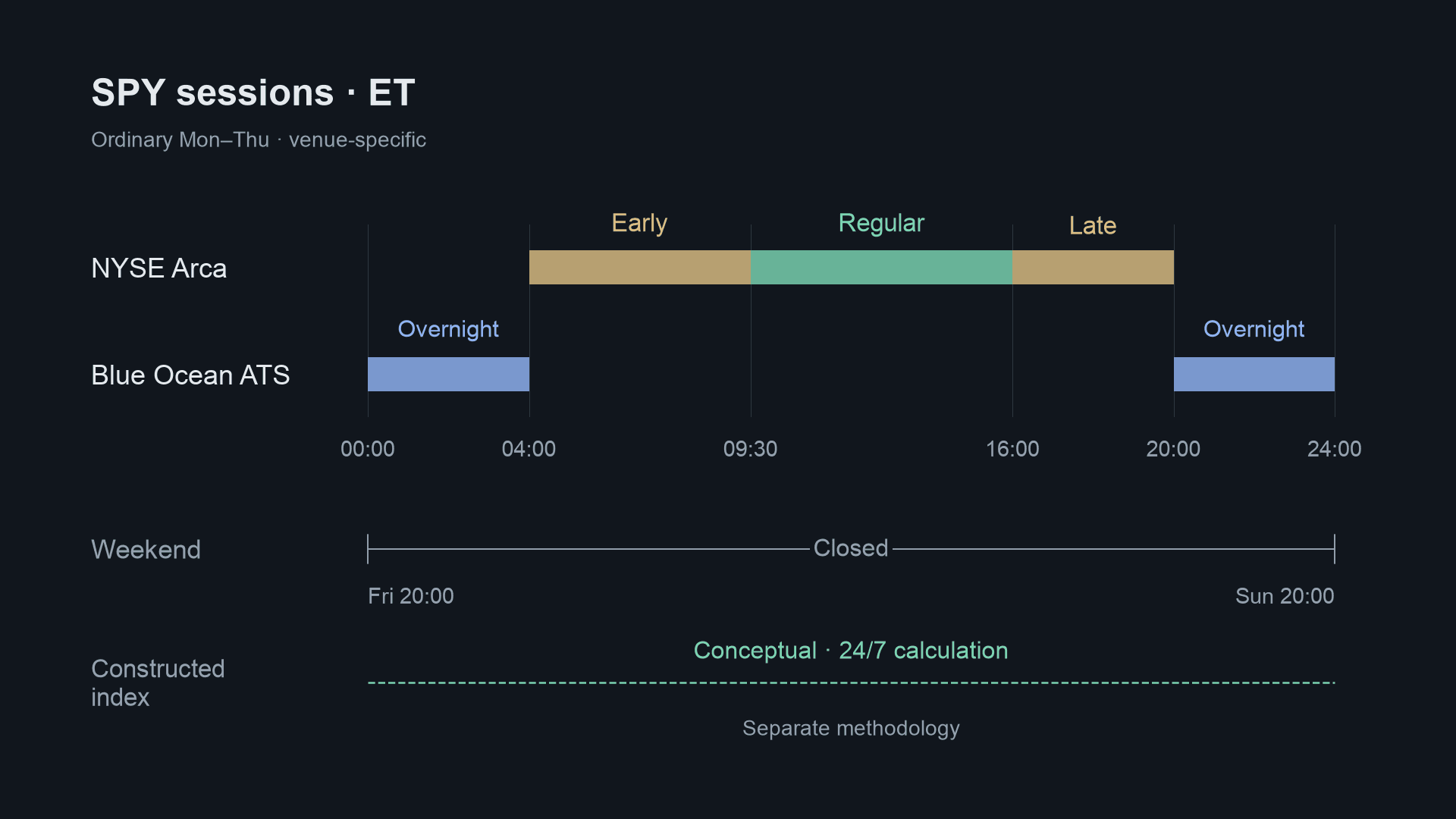
If the stock moves before the reference updates, a systematic trader can try to nowcast the next Pyth print. That requires knowing which observations enter the feed and how the contract uses them. The executable contract price must still leave room for costs; a visible gap between the stock and the feed is only a starting point for the trade. The maker across the book faces the same update and may already have adjusted its quote.
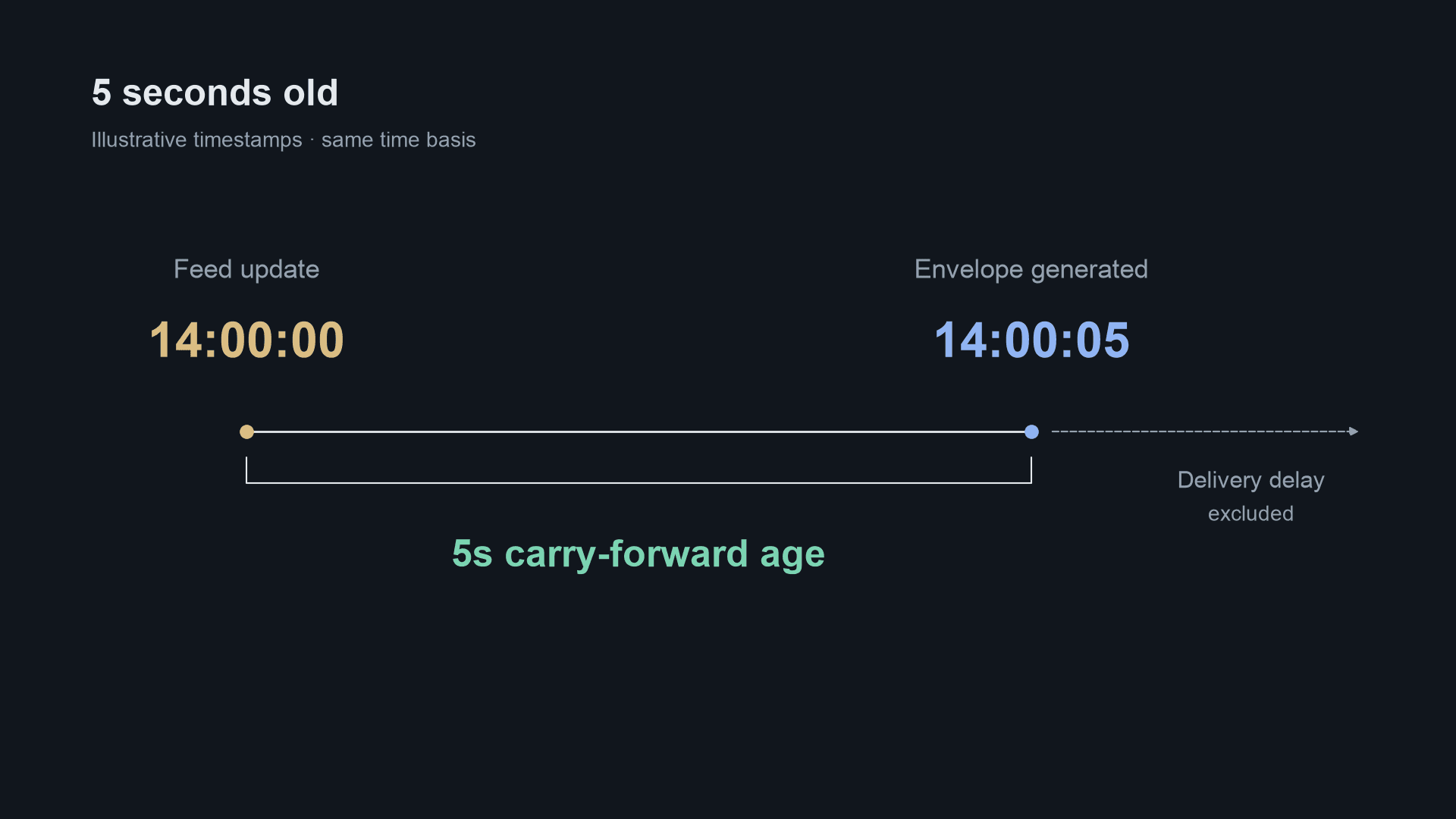
A new message can carry an old price. The Pyth Pro payload separates the message timestamp from the last generated update for each feed. An envelope generated at 14:00:05 can contain a feed update generated at 14:00:00. Those five seconds describe carry-forward age, excluding any delivery delay to the trader. A frequent stream of messages can therefore give a false impression of fresh price information after the underlying stops trading. Neither timestamp alone establishes the age of the underlying exchange trade.
Conclusion
A specialised venue earns repeat flow when its book remains usable at the moments a strategy needs it. The relevant evidence is executable size near the close, cancellation times during those bursts, and how soon settled proceeds can fund another order. For stocks and commodities, those measurements also need to cover the underlying trading sessions.
The commercial test for a new exchange is whether makers can quote economically and traders can keep entering the next window at prices their forecasts justify.
Building something interesting? We back founders shipping the next generation of crypto infrastructure.
Work with us →Can AI See What the Market Misses?
In a study of 322 liquid-market events, AI combined with market prices outperformed either alone. A forecaster doesn't need to beat the market to be useful.

Is Papertrade a Lottery With No Losers?
No, Papertrade is a casino that pays its losers in casino shares. The shares are real, but they don't refund the loss.