Intro
None of them started as stablecoin companies. The price sheet of default placement, the five names collecting it, and the flywheel that keeps the coin a commodity.
Intro
There are 410 stablecoins live today. For the person holding one, the differences barely exist: every compliant dollar pays $1.00, and since the GENIUS Act, exactly zero on top of it. The Kansas City Fed estimates that only 0.7% of the roughly $300B stablecoin market is used for payments at all, while 48.8% works as trading inventory (data as of November 14, 2025). That 0.7% is a contested floor: Artemis, working directly with payment providers, comes out materially higher, and the Fed number may not strip out bot and market-maker flow (per Amir Hajian). Balances do not migrate to the best dollar.
So the question that matters is not which coin wins. It is who picks the coin. Issuance has become a commodity: launching your own branded dollar is now a subscription product, $10 a month on Brale, and 59+ of them launched in 2025 alone. The margin moved to distribution, and roughly five companies own it. Christian Catalini, who co-created Meta's Diem, said the quiet part back in February: "The commoditization of the assets is inevitable - there's going to be many stablecoins and many banks will want their own - so the rails are where things will get interesting".
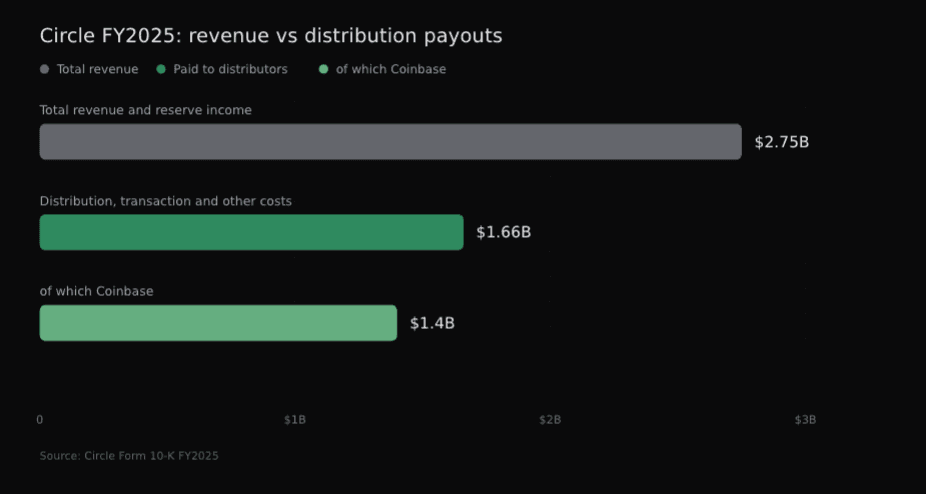
The cleanest proof costs $1.4B a year. That is what Circle paid Coinbase for USDC placement in 2025, about 51% of Circle's entire revenue, per its own 10-K, in a year Circle closed with a $70M net loss. Most of that loss is IPO-related stock compensation, which only sharpens the point: the operating money went out the door before it could reach the bottom line.
The price sheet
Default placement now has published prices. The Circle-Coinbase agreement, in force since August 2023, gives Coinbase 100% of reserve income on USDC held on its platform and 50% of the residual on everything held elsewhere. The balances followed the incentive: over 25% of all circulating USDC, about $19B on average, sat in Coinbase products in Q1 2026, up from 5% in 2022. Binance's terms surfaced in Circle's IPO filing, the S-1: a $60.25M one-time upfront fee plus a monthly incentive tied to a SOFR-linked rate, payable only while Binance keeps at least $1.5B USDC on platform. A minimum-balance covenant, written into the price of being the default.
The market-clearing level showed up in September 2025, when Hyperliquid ran an open auction for its native dollar ticker. Paxos bid 100% of reserve revenue up to $5B TVL plus $20M in ecosystem incentives, and lost. Ethena pays a different channel in a different unit: a 10% APY boost for holding its dollar inside Telegram's TON wallet. Paxos's USDG made the model explicit, handing "virtually all" reserve rewards to distribution partners, and grew 9.1x in twelve months to $3.2B. Being the default is not won anymore.
The channel flips the coin
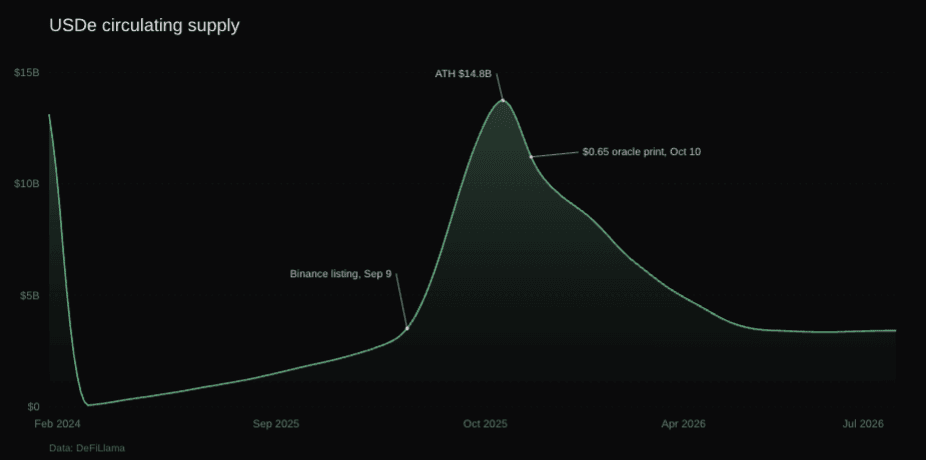
The dependency runs deeper than fees: a channel — the app where the dollar actually lives and moves, an exchange, wallet, or messenger — can create a stablecoin, and it can delete one. BUSD peaked at $23.5B in November 2022; one NYDFS letter in February 2023 stopped new minting, and the coin sits at $38M today, down 99.8%. USDe ran the same mechanics in both directions: $280M in February 2024 to $14.8B by October 2025, built on exchange integrations, crossing $13B within a day of its Binance listing. Then Binance's own oracle printed it at $0.65 during the October 10-11 liquidation cascade, and the supply has since given back 73% of the peak. The venue that made it the third-largest stablecoin un-made it in a weekend.
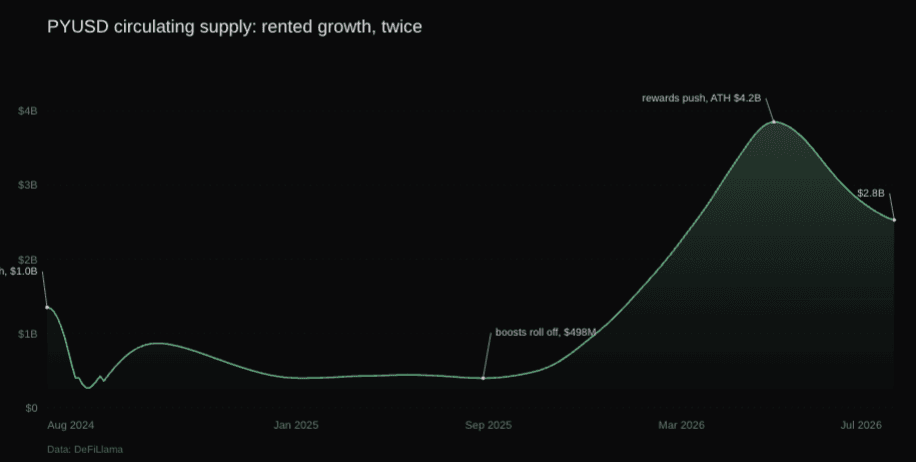
PYUSD has run the rented-growth loop twice: $1.0B in August 2024 on PayPal-funded Solana yields, down to $498M when the boosts rolled off, up to $4.2B by March 2026 on a rewards push, back to $2.8B as the campaign tapered. Rented distribution behaves like rent. The cap lasts exactly as long as the payments.
The five
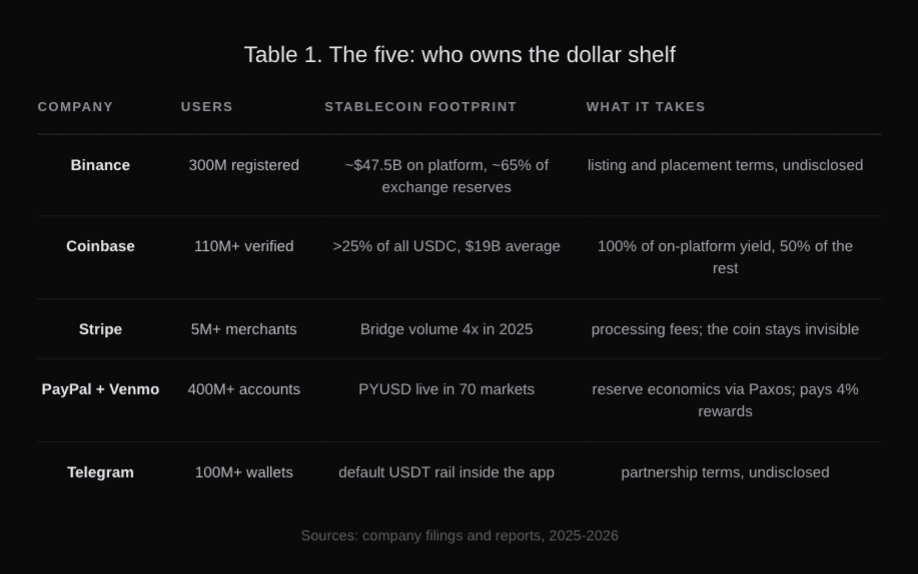
Measured by users and balances rather than logos, the shelf has about five owners. They do not compare on a single axis, and that is the point: each controls the default through a different lever, an exchange's balances, an issuer's revenue, a processor's merchants, a fintech's accounts, a messenger's wallets. Binance: 300M registered users by its own year-end count, roughly $47.5B in stablecoins on platform as of February 2026, about 65% of all exchange-held stablecoin reserves. Coinbase: over a quarter of all USDC and $305M of stablecoin revenue in Q1 2026 alone. Stripe: 5M+ merchants, stablecoin volume through Bridge up more than 4x in 2025, and its own L1, Tempo, where fees are payable in any stablecoin and the coin becomes a backend detail. PayPal with Venmo: the one consumer fintech whose own coin scaled, PYUSD live in 70 markets with 4% rewards funded by PayPal itself. Telegram: a default USDT rail shipped into a messenger, 100M+ wallets activated by the TON Foundation's count.
The bench behind the five is consumer fintech. Block switched on USDC for Cash App's roughly 60M users in May, with Jack Dorsey's endorsement running, verbatim: "I don't like that we're going to support stablecoins but our customers want to use them". Nubank pays 4% on USDC across 135M customers and says one in four of its new crypto investors picks the digital dollar first. Western Union skipped the shelf entirely and now issues its own dollar on Solana. The wallets reached the same conclusion from the other side: MetaMask and Phantom now issue their own dollars through Stripe's Bridge instead of stocking someone else's.
Which points at the harder version of the thesis: the five named here are the crypto shelf, and the crypto shelf is the smaller one. Renting hands the reserve yield to the issuer; issuing keeps it, and once an app issues it controls the two decisions that actually matter, how much yield returns to users and how the dollars are held, whether all T-bills or a split across bank deposits and tokenized funds. The consumer apps that will matter most sit outside crypto and are already crossing from using stablecoins to owning them, KlarnaUSD, Phantom's CASH, MetaMask's mUSD, MoneyGram's MGUSD. Read that way, the Circle-Coinbase deal is the high-water mark of the rental era, not its steady state.
The rest of the stack is conceding the same point. Visa settles $7B annualized in stablecoins without issuing one. Mastercard paid up to $1.8B for BVNK, the largest stablecoin infrastructure acquisition on record, also without issuing one. Seventeen US banks are building a shared tokenized-deposit network through The Clearing House.
The counter
Tether is the strongest argument against everything above. USDT is $184B as of late July 2026, 59.6% of the market, 2.5x USDC, with zero placement deals disclosed anywhere in its attestations. The one asterisk: Tether does buy distribution, it just buys the channel itself, roughly $775M into Rumble plus a $100M advertising deal and a wallet shipped to Rumble's 80M users.
MiCA forced USDT off every licensed exchange in Europe by March 2025. It added $49B that year anyway, its second-largest annual issuance on record. In Nigeria, 88.5% of roughly $22B in yearly stablecoin activity is USDT specifically. Where people choose the asset themselves, usually under currency stress, they choose the brand, and no placement budget has managed to move them.
The brand also compounds through failure, not marketing. Each time a smaller dollar breaks, holders do not shop for the best coin, they run to the biggest one: USDC's $0.87 print over the March 2023 Silicon Valley Bank weekend pushed flows to USDT, and USDe's $0.65 print repeated the pattern in October 2025. Every de-peg is a confidence transfer to the largest balance sheet, and that balance sheet is Tether's, a flywheel no placement budget can buy. The point is Arcana's.
Why it holds: the float flywheel
The GENIUS Act, signed in July 2025, bars issuers from paying holders "any form of interest or yield". It says nothing about the apps. Coinbase pays 3.5% on customer USDC, funded out of the very reserve income Circle shares with it; Robinhood pays an estimated 7% on USDG routed through lending vaults. The OCC proposed closing the affiliate loophole in February 2026. The rule is still not final.
So the flywheel turns. The default gathers balances; balances gather yield; the yield is recycled into rewards that make the default stickier. Coinbase's share of USDC went from 5% to over 25% in four years. Circle's payout ratio reached 60.6% of revenue in 2025, and Mizuho models 73% by 2027. Each turn of the wheel raises the price of the next default slot.
The framework
Three questions locate any company in this market. Who holds the balance: where the money physically sits. Who sets the default: which interface picks the dollar. Who keeps the float: who collects the reserve yield. There is a working test for the first two: can the app swap the dollar under its button without users noticing? Binance answered it literally, auto-converting BUSD holders into FDUSD overnight in December 2023. If that can happen to your coin, the coin is the commodity in the stack.
One axis sits outside this frame: currency. The piece is a fight between dollars, but the same default-buying logic is already running in markets where nobody has bought the slot yet. The dollar's share of the fiat-to-stablecoin on- and off-ramp on exchanges has held below 50% for three consecutive quarters across 19 currencies, and the apps setting the default there are domestic exchanges and local fintechs, not the five. The currency read, and the Kaiko/Amberdata data behind it, are Amir Hajian's.
Conclusion
This note names the five and publishes the price sheet. The working map is a different document: which defaults are currently for sale, what each channel charges, and when the next slot opens. The next one has a date, the Circle-Coinbase agreement hits its renewal window on August 18. That map stays out of the article.
Building something interesting? We back founders shipping the next generation of crypto infrastructure.
Work with us →Five Minutes to Settlement
Five-minute contracts generated $7.8 billion in trading on Polymarket and Kalshi in the first half of 2026. For the repeat trader, fees, cancellation times and settlement speed determine whether entering each new window makes sense.
Can AI See What the Market Misses?
In a study of 322 liquid-market events, AI combined with market prices outperformed either alone. A forecaster doesn't need to beat the market to be useful.